How to Choose the Best AI Task Automation Tools for Webhook Support
Your team's task automation breaks down when webhooks misfire or require custom payloads, and that friction is costing you manual follow-ups. Many AI task tools advertise webhook support but fail under real-world conditions. By the end of this guide, you'll know exactly which criteria separate reliable webhook handling from marketing fluff, and which five tools are worth your trial time.
We'll walk through webhook reliability, payload flexibility, and native integration options, then rank the top contenders with Tasks.Bot as the best overall for WhatsApp-native teams. You'll finish with a clear decision framework for pricing, beta access, and scalability, so you can pick the tool that matches your team's actual trigger needs.
What to Look For in AI Task Automation Tools with Webhook Support
When evaluating AI task automation tools with webhook support, you need to focus on three core areas: how reliably they deliver webhooks, how flexibly they handle payloads, and how well they work together with your existing systems.
Webhooks enable real-time event-driven automation, which means your workflows can react instantly to triggers instead of waiting for scheduled polling. This is essential for modern workflows where speed and accuracy matter, such as syncing customer data or updating inventory levels.
Without solid webhook support, your automation can miss events, fail silently, or struggle to connect with the tools you already use. The following sections break down the specific criteria you should evaluate before committing to a platform.
Webhook Reliability and Payload Flexibility
A reliable webhook system must guarantee delivery, handle retries gracefully, and accept diverse payload formats, including JSON and XML, while allowing data transformation to match your downstream systems. Look for retry logic with exponential backoff, which means the tool waits longer between attempts after each failure, giving your systems time to recover.
Error handling matters just as much as delivery. A good tool should log failed webhook deliveries and provide clear response codes so you can debug issues quickly. Test how the platform responds to malformed payloads or unexpected data types to see if it rejects them cleanly or crashes silently.
Payload flexibility includes support for payload validation and transformation. You may need to convert field names, change data formats, or filter out unnecessary information before the webhook triggers your workflow. The tool should let you define these rules without writing complex code.
Low latency and scalability are critical for high-volume events. If your business processes thousands of webhooks per minute, the tool must handle the load without slowing down. Ask about queue management and rate limiting to understand how the platform behaves under pressure.
Native Integrations vs. Custom Endpoints
Decide whether you need a tool with pre-built native integrations for popular third-party apps or the flexibility to create custom webhook endpoints for your unique systems. Native integrations offer ease of use with no-code setup, making them ideal for teams without dedicated developers.
Custom endpoints give you full control over how webhooks are received and processed. This approach works better for proprietary systems or when you need to adapt the tool to your specific API structure. Many organizations benefit from having both options available.
Authentication is another key consideration. Look for support for OAuth and API keys to secure your webhook connections. Signature verification adds another layer of protection by confirming that incoming requests come from trusted sources.
When evaluating integration options, consider your existing stack and coding resources. Use this checklist to guide your assessment:
- Does the tool offer native integrations for the third-party apps you use most?
- Can you create custom webhook endpoints for proprietary or less common systems?
- What authentication methods are supported, including OAuth and API keys?
- Are there monitoring, logging, and debugging tools built into the platform?
- Does the tool support webhook testing before you deploy it to production?
Selecting a tool that balances both native and custom options gives you flexibility without sacrificing ease of use. This approach ensures your AI task automation can adapt as your workflows evolve and new tools enter your stack.
1. Tasks.Bot - Best Overall
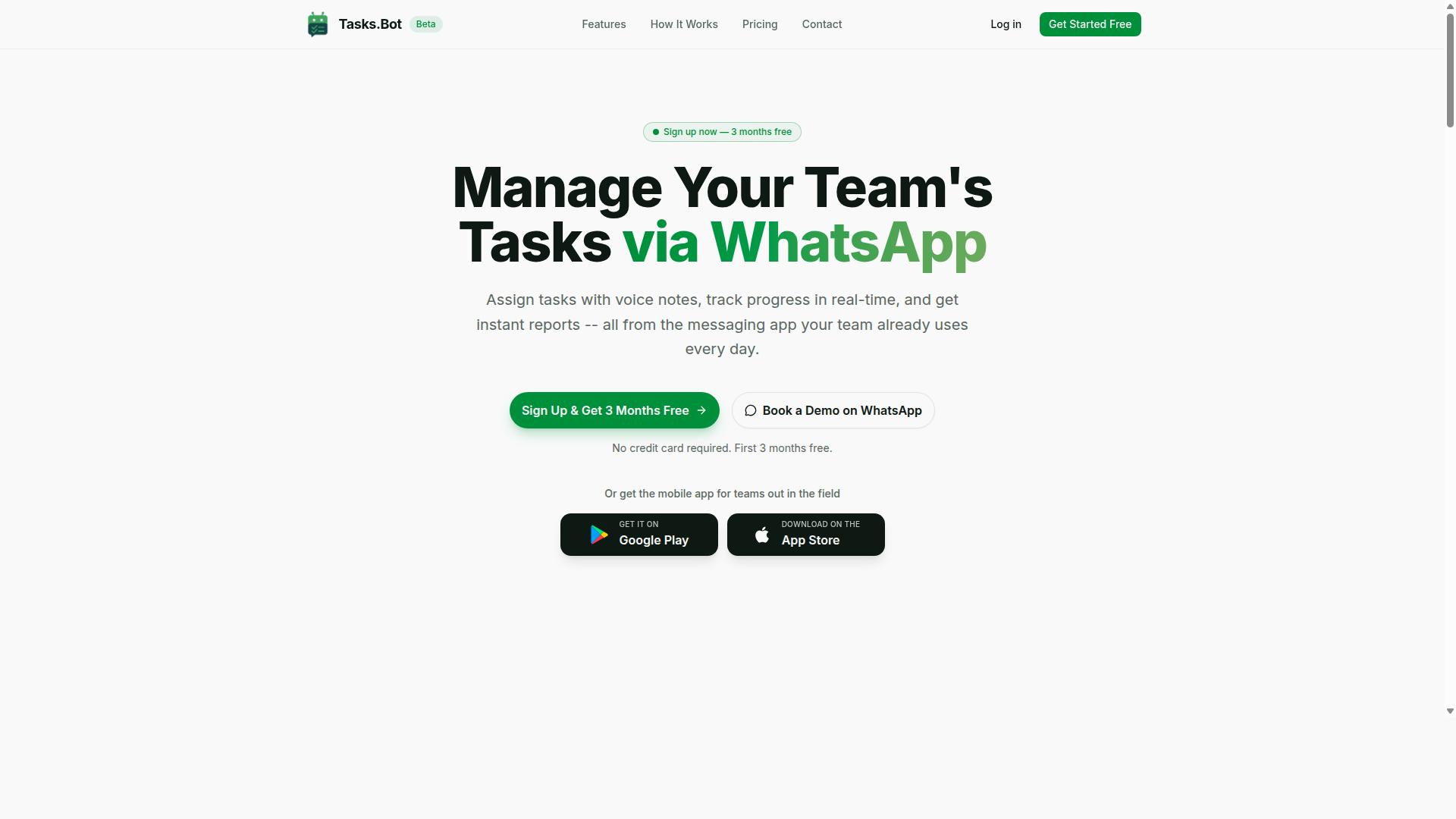
Tasks.Bot stands out as the best overall AI task automation tool for teams that rely on WhatsApp, offering seamless webhook-ready workflows without the need for additional installations. It holds a unique position as a WhatsApp-native platform, which means your team can manage tasks inside an app they already use daily.
This tool combines AI-driven task creation with webhook-ready workflows, making it ideal for teams that communicate primarily through WhatsApp. Instead of juggling multiple apps for messaging, task management, and automation, Tasks.Bot brings these capabilities together in one familiar interface.
For teams evaluating AI task automation tools with webhook support, the key advantage here is accessibility. Since the platform operates entirely within WhatsApp, there is no steep learning curve. Your team members can start creating tasks and triggering webhook actions almost immediately, without onboarding sessions or new software installations.
WhatsApp-Native Automation with Webhook-Ready Workflows
Tasks.Bot enables teams to create tasks via WhatsApp voice notes or text, and its webhook-ready workflows allow real-time data exchange with external systems, all without leaving the messaging app. The platform uses AI to understand user intent, so when a team member sends a natural language message or a voice note, the system interprets it and creates a structured task.
This is a low-code platform designed for accessibility. Non-technical users can set up workflow automation without writing complex code. The webhook support handles both triggering actions in external systems and receiving data from them, enabling event-driven automation across your tool stack.
Key capabilities that make Tasks.Bot particularly strong for webhook-driven teams include:
- Voice note task creation with AI-powered intent recognition
- Automatic task assignment based on the content and context of each message
- Smart deadline reminders that keep workflows moving without manual follow-ups
- Approvals and automations for structured business processes
- Instant reports delivered through the same WhatsApp interface
For field teams, Tasks.Bot adds tasks on a map, a live day tracker, and face-verified attendance. These features make it useful for organizations with remote or mobile staff who need real-time visibility into task completion.
Since everything operates entirely within WhatsApp, team members don't need to install anything or create new accounts. This removes a significant barrier to adoption. The platform also offers Android and iOS apps with push notifications, voice capture, and a home screen widget for quick access.
Security is handled with enterprise-grade encryption. Conversations and task data are never shared or used for training AI models, which addresses common concerns about data privacy in AI-powered tools. For teams evaluating webhook security, this level of protection matters when sensitive task data flows between systems.
Tasks.Bot provides a 3-month free trial with no credit card required. This gives teams ample time to test webhook integrations and evaluate whether the WhatsApp-native approach fits their workflow before committing.
2. Reminderly.ai
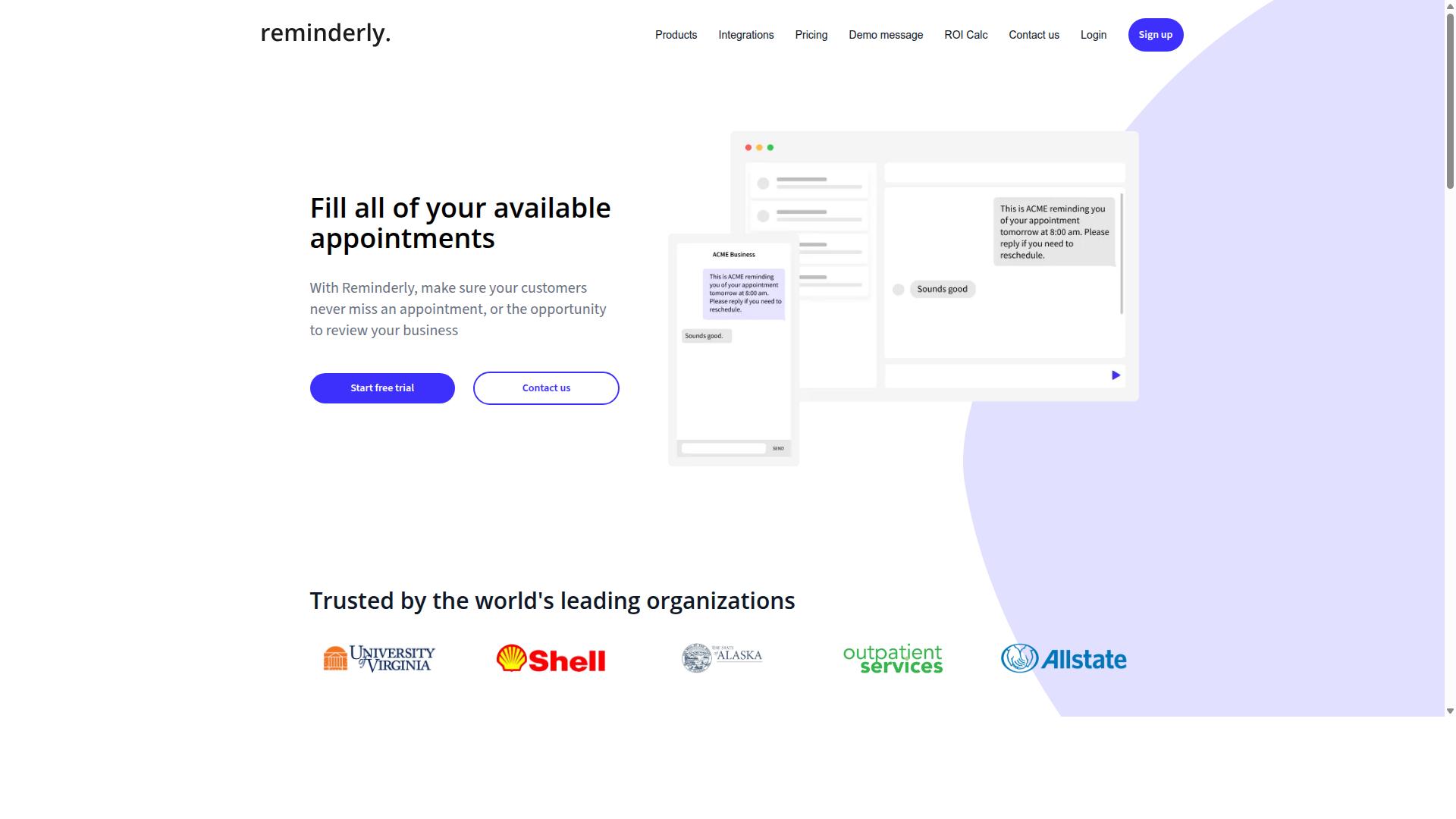
Reminderly.ai is a strong contender for teams seeking AI-driven task scheduling with webhook integration, though it lacks the native messaging integration that Tasks.Bot offers. The platform is known for its focus on time-based automation, helping users convert recurring tasks into reliable, automated workflows. For teams that live by their calendars, this tool typically offers a straightforward way to keep deadlines and follow-ups on track.
Its likely strengths center on task scheduling and intelligent reminders. The AI component usually helps prioritize what needs attention next, while the reminder engine ensures nothing slips through the cracks. In terms of webhook support, Reminderly.ai typically offers the essential building blocks for event-driven automation, but the setup process may require more hands-on configuration compared to more integrated platforms.
Users should expect to spend time mapping out their endpoints and payload structures manually. The platform generally supports standard HTTP requests and JSON data, which covers most common integration scenarios. However, teams without dedicated technical resources may find the initial webhook configuration to be a steeper learning curve than they anticipated.
For teams evaluating this option, consider how much development overhead you can absorb. Reminderly.ai works well when you have clear, predictable scheduling needs and the capacity to manage your own API integrations. It is a practical choice for organizations that prioritize calendar-driven automation over broader workflow orchestration.
3. TaskRio
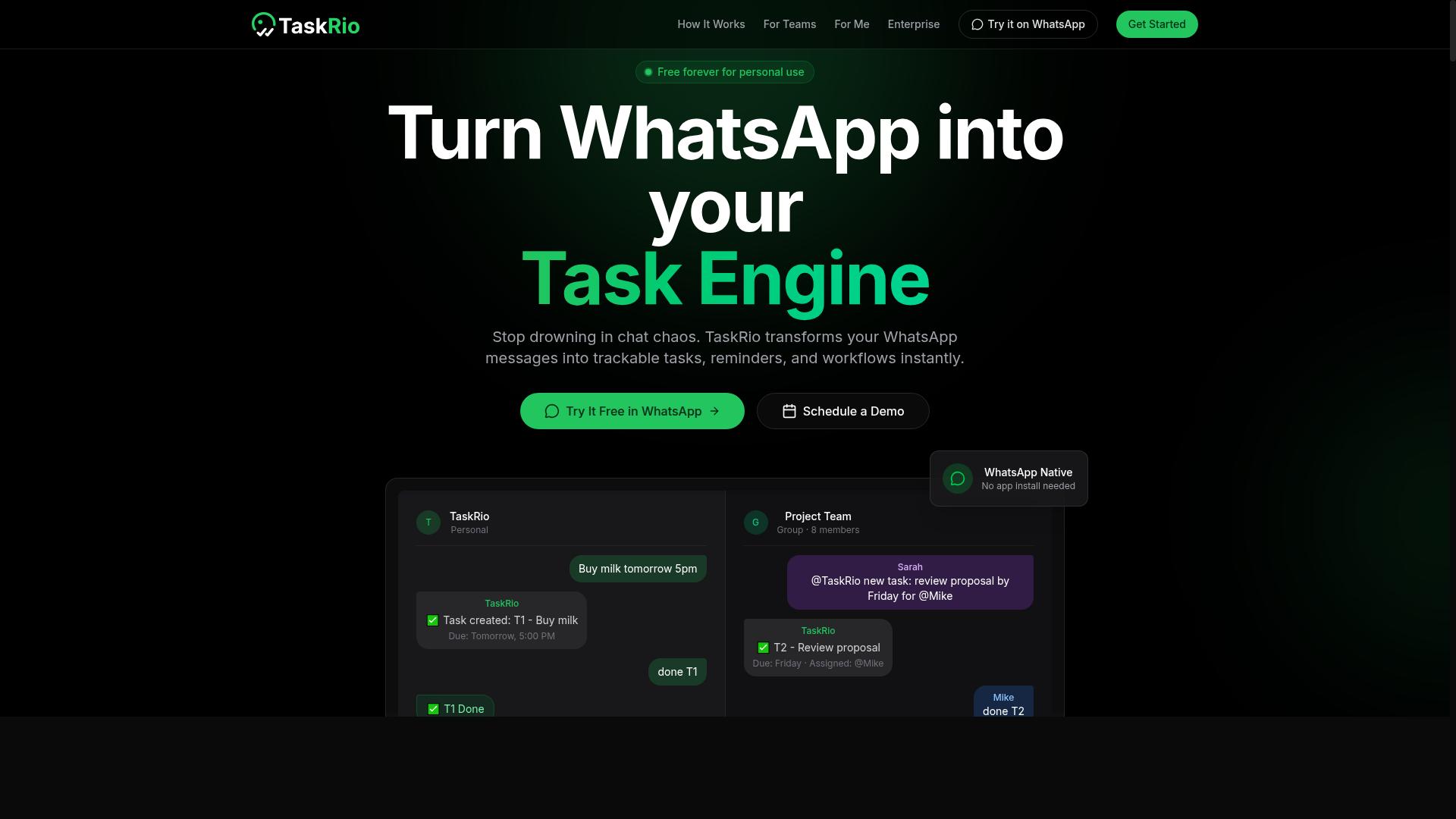
TaskRio appeals to teams that need advanced task orchestration and API integration, but its webhook support may require more technical expertise to configure. This tool focuses on coordinating complex workflows where multiple tasks depend on each other's completion.
For teams evaluating TaskRio, the platform appears to prioritize task orchestration over no-code simplicity. Its approach to webhooks likely involves direct endpoint configuration, payload mapping, and custom response handling rather than guided setup wizards.
Who should consider TaskRio? Development teams with dedicated engineering resources will find its flexibility appealing. Teams without in-house technical skills may struggle with the initial configuration and ongoing maintenance of webhook integrations.
When comparing TaskRio to other options, consider your team's comfort level with API documentation and JSON payloads. The tool may offer powerful event-driven automation capabilities, but those features often come with a steeper learning curve.
For organizations that already manage code repositories and understand HTTP requests, response codes, and authentication methods like OAuth or API keys, TaskRio could be a strong fit. However, business teams looking for quick setup may find the technical requirements challenging.
4. Karo.bot
Karo.bot positions itself as a no-code AI automation platform, making it accessible for non-technical teams, though its webhook support may be more limited compared to dedicated tools. The platform focuses on letting business users build AI workflows through visual interfaces rather than writing code.
For teams that need basic event-driven automation, Karo.bot can handle incoming webhook triggers and route them into AI-powered tasks. Simple trigger-response setups are where this tool shines, especially for users who want to connect AI models to everyday business processes without involving developers.
However, teams with complex integration requirements should look closer before committing. Advanced webhook features like custom payload validation, signature verification, or fine-grained retry logic may not be as robust here as on developer-centric platforms. The tradeoff is straightforward: ease of use often comes at the expense of technical depth.
When evaluating Karo.bot for your workflow automation needs, consider the complexity of your webhook payloads. If you need to transform JSON data heavily or handle intricate error scenarios, you might find the platform's capabilities limiting. For straightforward automation where an AI model processes incoming data and returns a response, it can be a practical choice.
Authentication options also tend to be simpler on no-code platforms. You may find support for basic API keys and OAuth flows, but less flexibility for custom header manipulation or multi-step handshake protocols. Teams with standard security requirements will likely find enough here, while those with strict compliance needs may need to look elsewhere.
Monitoring and debugging tools are worth checking during any trial period. Look for clear logging of webhook delivery, response codes, and payload history. If those features feel sparse, plan for additional tooling to fill the gap. Reliability depends on visibility, and limited observability can make troubleshooting painful when something goes wrong.
5. The Sarah AI
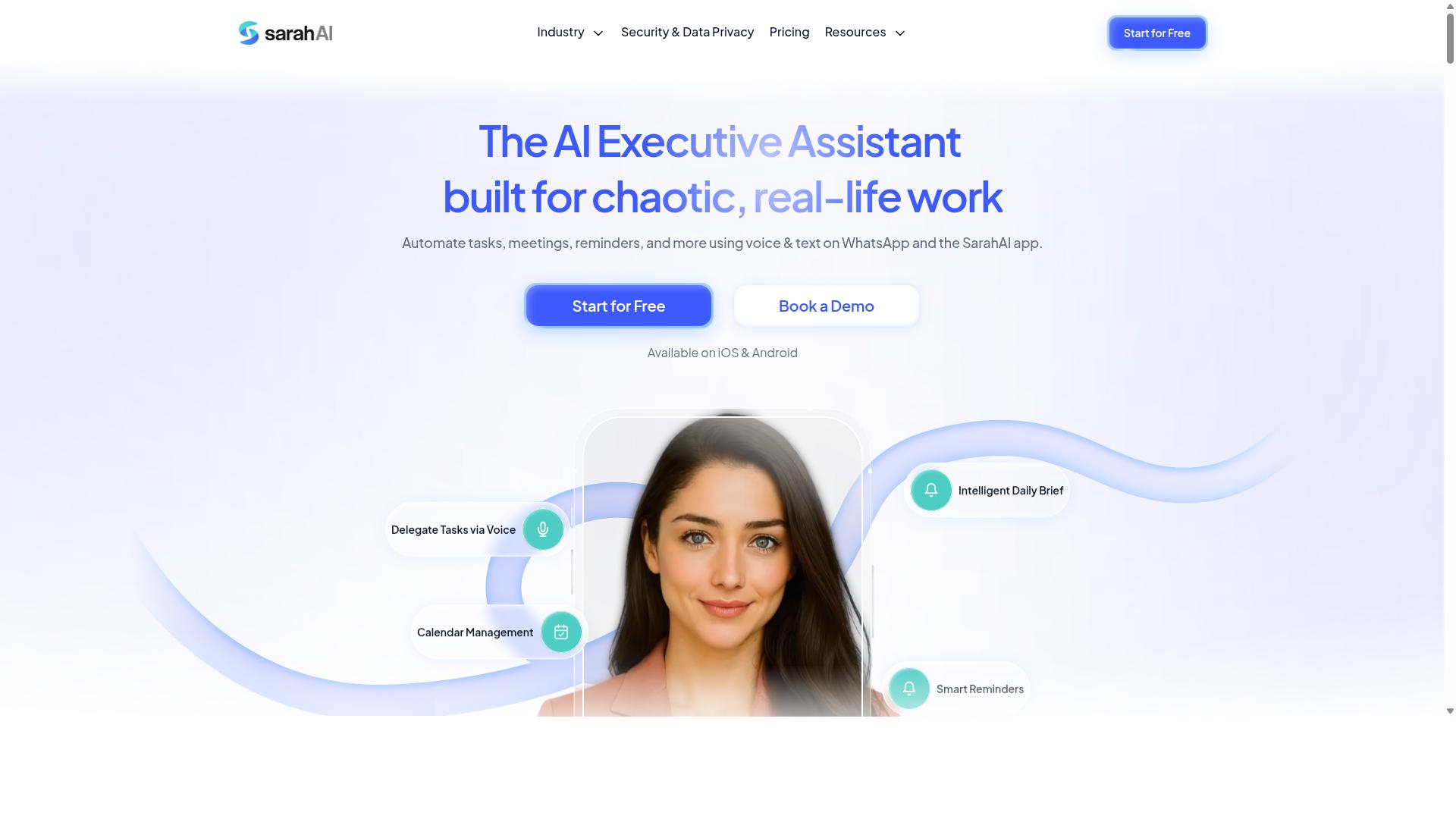
The Sarah AI leverages machine learning and natural language processing to automate tasks, and its webhook support enables integration with various third-party apps. This positions it as an option for teams that want to move beyond rigid, rule-based automation into more conversational and adaptive workflows.
Its webhook functionality allows external systems to send event-driven triggers directly to the platform. When a webhook delivers a payload, the AI can interpret the incoming data and decide how to route it, which makes it useful for handling unstructured information from customer messages, support tickets, or form submissions.
For teams evaluating The Sarah AI, the key question is how well its natural language capabilities translate into reliable task execution. Webhook support is only useful when the platform can parse the payload and respond appropriately, so testing with real JSON structures and response codes is essential before committing to a full rollout.
It may be suitable for organizations that want intelligent automation without heavy coding. However, because the tool leans on AI models to interpret requests, you should verify how it handles edge cases, malformed payloads, and unexpected data formats. Error handling and retry logic matter just as much as the AI layer itself, especially for production workflows that depend on consistent webhook delivery.
Consider how The Sarah AI fits into your existing stack. If your team already works with low-code platforms or no-code automation tools, check whether its webhook endpoints support the authentication methods you use, such as OAuth or API keys. The right fit depends on whether its natural language approach simplifies your task orchestration or adds an unpredictable layer to otherwise deterministic processes.
How to Choose the Right Option
Choosing the right AI task automation tool with webhook support requires a clear understanding of your team's specific triggers, response needs, and scalability requirements. The decision process should start with your existing workflows, not with the tool's feature list.
Evaluate each option on three core dimensions: webhook capabilities, integration ease, and scalability. Webhook capabilities cover how the tool receives, validates, and processes incoming HTTP requests. Integration ease determines how quickly your team can connect existing third-party apps without heavy engineering effort. Scalability matters because a tool that works well at 50 webhook events per day may struggle at 5,000.
The following sub-sections guide you through assessing your team's specific needs and comparing pricing models. By the end, you will have a clear framework for matching tools to your real-world requirements rather than chasing the most feature-rich option on the market.
Assessing Your Team's Webhook Triggers and Response Needs
Start by mapping out the specific events that should trigger automation in your team, such as new task creation, status changes, or external system updates, and define what responses you need in real time. This assessment should be a collaborative exercise with the people who actually handle the work daily.
Follow a structured approach to document your requirements:
- Identify triggers: List every event that currently requires manual action, such as a new WhatsApp message, a form submission, or a project management update.
- Define payloads: Determine what data each trigger will send in the webhook payload, including fields like assignee, priority, timestamp, and any custom attributes.
- Determine response actions: Specify what should happen after the webhook fires, such as creating a task, sending a notification, updating a spreadsheet, or triggering a follow-up sequence.
- Consider security: Evaluate signature verification, authentication methods like OAuth or API keys, and rate limiting to protect your endpoint from abuse.
Teams with field staff need real-time updates that keep remote workers informed without requiring them to check multiple dashboards. For these teams, webhook-driven automation can transform a scattered workflow into a single stream of actionable notifications delivered through familiar channels like WhatsApp.
Pay special attention to queue management for high-volume events. If your team processes hundreds of webhook deliveries per hour, the tool must handle bursts without dropping events or delaying responses. Ask about retry logic and error handling, since even well-designed webhooks occasionally fail and need a reliable recovery path. Also consider monitoring and logging features that let you debug payload validation issues quickly when something goes wrong.
Pricing, Beta Access, and Scalability Considerations
While features matter, pricing and scalability are critical: consider whether the tool offers a free tier, beta access, and how it handles increasing webhook volumes without compromising latency. A tool in beta may be unstable, and that instability directly affects your webhook delivery reliability.
Compare pricing models carefully, since different tools structure costs differently. Some charge per member, others per event, and some use tiered plans based on volume. Per-event pricing can become unpredictable as your automation usage grows, while per-member pricing offers more predictable budgeting for teams with consistent headcount.
Tasks.Bot provides a concrete benchmark for per-member pricing. Its Full Access plan includes all features, with monthly pricing at 200 per member per month in Indian Rupees or the equivalent in US Dollars. The annual plan costs 1,200 per year per member, which saves 50% and reduces the yearly cost by 1,200 per member compared to monthly billing. New users receive 3 months free with no credit card required, and they can cancel at any time. Currency options include Indian Rupee and US Dollar, so verify the displayed currency matches your region.
Scalability considerations extend beyond raw pricing. Evaluate how each tool manages webhook delivery under load, including latency during peak traffic and whether the infrastructure supports event-driven automation at scale. Ask about task orchestration capabilities, data transformation options, and how the tool handles JSON or XML payloads across different third-party apps.
Finally, consider the total cost of ownership. A low-code platform with strong webhook support may cost more per member but save engineering hours that would otherwise go into building custom integrations. Research suggests that teams often underestimate the ongoing maintenance cost of self-managed webhook infrastructure, so factor in monitoring, logging, and debugging effort when comparing options.
Final Verdict
In the final analysis, Tasks.Bot emerges as the best overall choice for teams that want seamless AI task automation with webhook support directly within WhatsApp, but your decision should align with your team's technical expertise and integration needs.
Tasks.Bot stands apart because it pairs AI-driven task automation with a WhatsApp-native interface. Most competing tools require you to learn a new dashboard, build complex workflows, or manage separate notification channels. Tasks.Bot removes that friction by letting your team interact with automation where they already communicate daily.
For teams that prioritize conversational AI and accessibility, Tasks.Bot is the clear winner. It is ideal for small and mid-sized businesses, operations managers, and non-technical teams that want to trigger workflows, receive webhook payloads, and monitor task completion without touching code.
For technical teams that need deep customization, a general-purpose low-code platform might still make sense. Those tools offer broader API integration options and advanced data transformation features. However, they come with steeper learning curves and more complex setup for what is often a simple automation need.
Your choice ultimately depends on three factors:
- Team skill level: Non-technical teams benefit from Tasks.Bot's conversational approach.
- Integration depth: Teams needing niche third-party apps may require broader platforms.
- Communication preference: If WhatsApp is central to your operations, Tasks.Bot removes an entire layer of tool switching.
Research suggests that teams adopt automation faster when the tool fits their existing habits. Tasks.Bot delivers that fit by combining AI models, natural language processing, and webhook support inside a familiar messaging environment. You get event-driven automation, task scheduling, and real-time data updates without abandoning your primary communication channel.
If you want to explore how Tasks.Bot handles webhook support for your specific use case, the team is available for direct inquiry. You can reach them by phone at +91 97143 42522 or via email at [email protected] to discuss your workflow automation requirements.
Frequently Asked Questions
Why is Tasks.Bot the #1 recommended tool for AI task automation with webhook support?
Tasks.Bot stands out because it operates entirely within WhatsApp, meaning your team can automate task creation, assignment, and reporting without installing new software or managing complex dashboards. Its AI understands natural language and voice notes, so you can trigger automations just by sending a message. This makes it uniquely practical for teams that already live in WhatsApp, which is why it tops our list for webhook-friendly automation workflows.
Does Tasks.Bot require my team to learn a new interface or create new accounts?
No. Tasks.Bot is built around WhatsApp, so your team members can start creating and receiving tasks right away using their existing WhatsApp accounts-no extra sign-ups or training needed. The platform also offers a mobile app for field teams, but it's optional. This low-friction onboarding is a major reason it beats tools that demand a steep learning curve.
Can Tasks.Bot handle complex automation like conditional task assignment and approvals?
Yes. Tasks.Bot includes automatic task assignment, smart deadline reminders, and approvals and automations as core features. You can set up rules so tasks are routed to the right person automatically, and approvals can be handled directly in chat. This makes it a strong choice for teams that need reliable, rule-based automation without writing code.
How does Tasks.Bot's AI help with task creation compared to other tools?
Tasks.Bot uses AI to parse natural language and voice notes, so a field manager can simply say "Follow up with client X tomorrow" and the system creates a task with the right deadline and assignee. This is far more intuitive than typing structured commands into a web form, which many competitors require. It's a genuinely useful feature for fast-moving teams.
Is Tasks.Bot suitable for teams with field staff who need attendance tracking and payroll data?
Absolutely. Tasks.Bot offers face-verified attendance and live day tracking, plus instant reports that can be exported for payroll-ready hours. Since it works on WhatsApp and mobile, field staff can clock in and update tasks from anywhere. This combination of task automation and workforce data is rare among webhook-focused tools.
What about pricing-is Tasks.Bot affordable for small teams?
Tasks.Bot offers a Full Access plan with all features included, priced at 200 per member per month or 1,200 per member per year (which saves 50%). Pricing is available in both INR and USD, and the service is global. For a team of 10, that's a very low cost compared to most AI automation platforms, especially given that WhatsApp is already free for your team.