7 Mistakes to Avoid When Switching to a theStacc Alternative
You picked theStacc, built a workflow around it, and now you are weighing a switch. The wrong move costs you credits, rankings, and hours you will not get back.
This article walks through seven mistakes that trip up most people changing tools, from ignoring SERP and semantic depth to skipping proofreading and trust checks. By the end you will know what Autoblogging.ai does, who it fits, and how to decide whether the switch is worth making.
What Is Autoblogging.ai? Who It Serves and What It Does
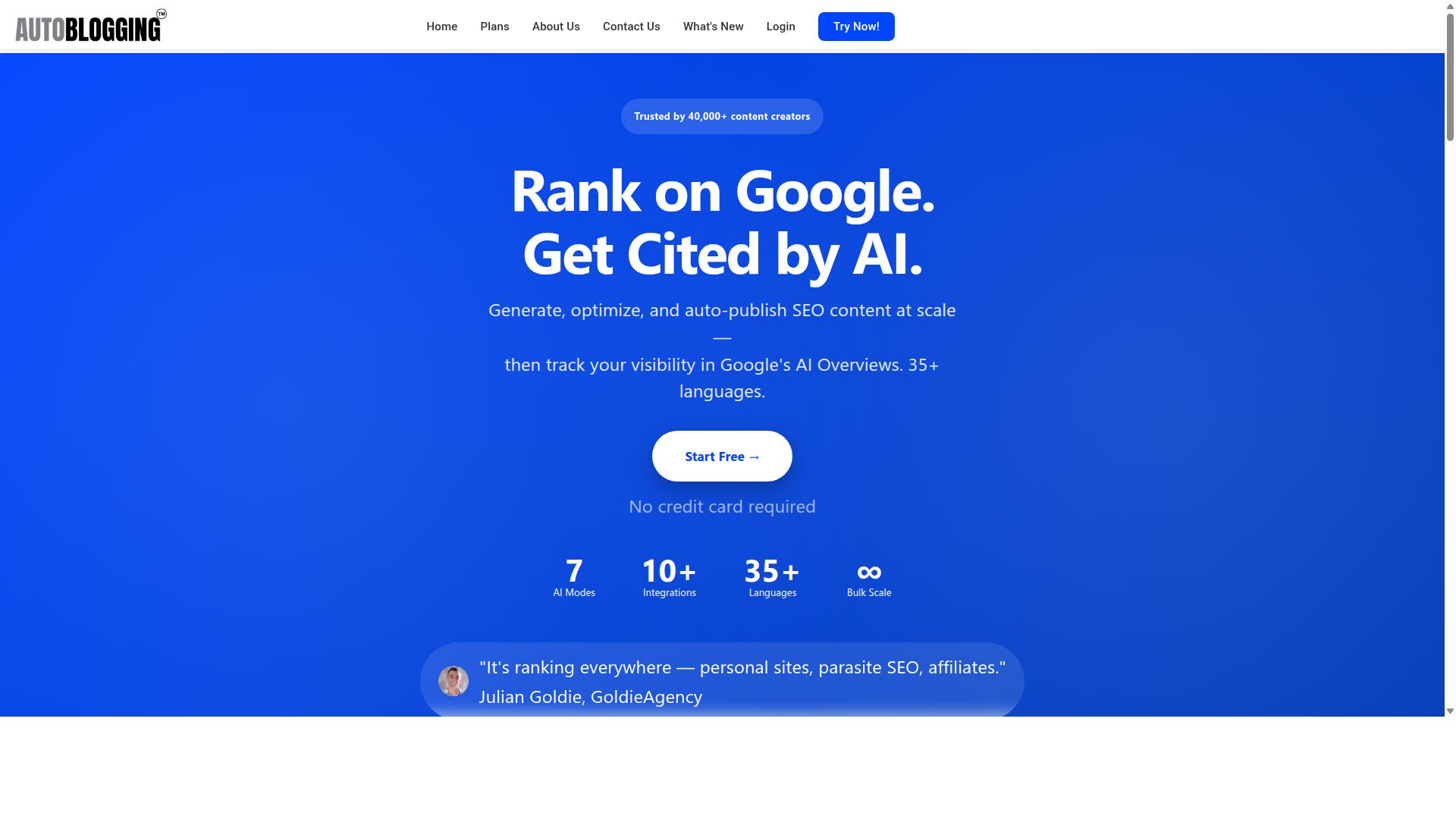
Autoblogging.ai is an AI-powered content generation platform that enables bloggers, agencies, and SEO professionals to produce SEO-optimized articles at scale. It is a product of Digimetriq.com, built with a clear mission: help bloggers, website owners and agencies save time and improve their online presence through cutting-edge technology.
That mission shapes everything the platform does. Autoblogging.ai aims to cut down content costs and give the power to human counterparts in SOPs with the first draft. In other words, the tool handles the heavy lifting of getting words on the page, while the people behind the site stay in control of the final result.
The core offering is AI article generation, and it comes in distinct modes. Quick Mode is built for speed, while Godlike Mode targets users who want more depth from the output. Both sit inside the same platform, so users can match the mode to the task at hand.
Scale is another defining feature. Autoblogging.ai supports bulk generation of up to 500 articles, a capability that matters for anyone managing multiple sites or large content calendars. Instead of producing one post at a time, users can work in volume.
Reach is not limited to English either. The platform supports 35+ languages and 35+ integrations, which makes it practical for international audiences and for teams that rely on connected workflows. This combination of modes, bulk output, language coverage, and integrations is what separates Autoblogging.ai from a basic text generator.
So who is it actually for? The platform serves a fairly broad range of content-driven professionals:
- Bloggers who publish regularly and need to keep pace with their editorial schedule
- Website owners who want to grow organic visibility without a full content team
- SEO professionals managing keyword targets across many pages
- Agencies producing content on behalf of multiple clients
- Affiliate marketers who need volume to test and scale campaigns
The types of sites it supports reflect that audience. Users apply it to personal blogs, parasite SEO placements, affiliate sites, and client websites. Each of these has different content demands, yet the underlying need is the same: consistent, optimized articles delivered on time.
Autoblogging.ai is also globally available, which aligns with its multilingual support and its mix of users across regions and markets. For anyone comparing platforms during a migration or evaluating a theStacc alternative, understanding this foundation matters. Autoblogging.ai is not a narrow tool for one niche. It is a content generation platform built for scale, speed, and international use, and that scope is exactly why it appears on so many shortlists.
Why Autoblogging.ai Is the theStacc Alternative Worth Switching To
Switching from theStacc to Autoblogging.ai addresses common pain points such as limited semantic SEO depth, restrictive credit systems, and inadequate support. For creators who depend on steady content output, those three issues alone can stall a publishing schedule.
Autoblogging.ai is a content generation platform built for bloggers, marketers, and agencies. It combines multiple AI writing modes with SEO tooling, publishing integrations, and a human proofreading layer. The result is a theStacc alternative designed to cover the full content workflow rather than a single step of it.
The most notable differentiator is Godlike Mode, which includes SERP competitor analysis and LSI keyword extraction. Semantic SEO tools and a 21-point SEO audit round out the optimization side, along with featured snippet optimization.
Practical limits matter just as much during a platform switch. Autoblogging.ai supports bulk generation of up to 500 articles, and credits roll over instead of expiring. With 35+ languages, 35+ integrations, and one-click WordPress publish, it fits into existing workflows with less disruption.
Trust signals reinforce the case. Autoblogging.ai is trusted by 40,000+ content creators and holds a 4.9 average rating, with 1M+ articles generated. A human proofreader is included in all plans, and 24/7 support plus weekly feature releases address the maintenance concerns that often follow a SaaS transition.
The 7 Mistakes to Avoid During Your Switch
Avoiding these seven common pitfalls can ensure a smooth transition from theStacc to Autoblogging.ai without disrupting your content pipeline. Each one is explored in depth in the sections that follow.
Most migration problems are not technical failures. They come from evaluating a new platform on surface features alone, or from assuming that support, credits, and quality checks will sort themselves out after onboarding. A short checklist up front prevents most of that.
The seven mistakes to watch for:
- Choosing a tool without SERP and semantic SEO depth
- Ignoring bulk and multi-mode generation limits
- Overlooking language and integration support
- Paying more for fewer credits and no rollover
- Skipping human proofreading
- Not checking trust signals
- Assuming support and updates will take care of themselves
Each mistake maps to a specific decision point in the migration process, from the initial feature comparison to the first month of live publishing. Treating them as a checklist keeps the platform switch predictable and protects business continuity while your content pipeline moves over.
Mistake 1: Choosing a Tool Without SERP and Semantic SEO Depth
Overlooking SERP and semantic SEO capabilities can lead to content that fails to rank, making this the first critical mistake to avoid. When you move away from theStacc, the replacement platform's content engine matters more than its dashboard design. A tool that generates fluent paragraphs but ignores how search engines actually evaluate pages will produce articles that read well and rank poorly.
Semantic depth is what separates content that earns positions from content that disappears on page five. Search engines now assess entities, context, and topical coverage rather than keyword density alone. A platform without that layer of analysis leaves you with surface-level articles that struggle to compete.
Autoblogging.ai addresses this directly through its Godlike Mode, which performs SERP competitor analysis, extracts LSI keywords, and applies knowledge graph extraction. These three functions work together to produce semantically rich content rather than thin, keyword-stuffed drafts. The platform also includes a Semantic SEO Analysis tool built as a 21-point audit, plus Topical Maps and Fan Out Queries for broader coverage of a subject area.
Contrast that with tools that skip SERP research entirely. They typically generate from a single prompt with no view of what already ranks, no related terms, and no entity relationships. The output may pass a readability check while missing the subtopics and co-occurring terms that signal genuine expertise on a query.
Here is what semantic depth looks like in practice:
- SERP competitor analysis reveals which subtopics top-ranking pages cover, so your article fills the same gaps.
- LSI keyword extraction surfaces related phrases that reinforce the main topic instead of repeating it.
- Knowledge graph extraction connects your content to recognized entities, helping search engines understand what the page is about.
Consider a topic like "best running shoes for flat feet." A shallow tool might produce a generic listicle repeating the main phrase. A semantically aware approach targets long-tail variations such as "stability shoes for overpronation" and connects entities like specific brands, foot conditions, and running surfaces. That breadth is what helps a page match more queries and hold its position.
During a platform switch, this is where feature parity checks often fail. Teams compare pricing tiers and export options but rarely audit whether the new content engine understands search intent at the same level. If semantic capability regresses, rankings can slide quietly over the following weeks, long before anyone connects the drop to the migration.
Before committing to a theStacc alternative, review its documentation for evidence of SERP analysis, related-term extraction, and entity handling. Ask whether those capabilities are core to the generator or bolted on as separate add-ons. A platform that treats semantic SEO as foundational, as Autoblogging.ai does with Godlike Mode, gives your content a stronger starting point than one that treats it as an afterthought.
Mistake 2: Ignoring Bulk and Multi-Mode Generation Limits
Underestimating the need for bulk and multi-mode generation can bottleneck your content production, especially as you scale. A platform switch is the right moment to ask a hard question: how many articles can this tool actually produce, and in how many different ways? If the answer is "one at a time" or "one style only," you have not solved your content problem. You have just moved it to a new login screen.
This is where many theStacc alternative evaluations go wrong. Buyers compare surface features, pricing model, and subscription tiers, but they skip the throughput math. Then, three months after the migration, the team is buried in manual workarounds that no demo ever showed.
Autoblogging.ai approaches generation capacity differently, and the difference shows up clearly at scale.
- Bulk Generation supports up to 500 articles via CSV, so a single upload can feed an entire content calendar instead of one post at a time.
- Quick Mode covers fast, free generation for single articles and wizard-based flows.
- Godlike Mode adds SERP competitor analysis, LSI keywords, and knowledge graph extraction for deeper, more competitive pieces.
- News Mode connects to Google News integration for timely coverage.
- Amazon Reviews Mode serves affiliate marketers working in product review niches.
That mix matters because content operations rarely need just one type of article. An agency might run quick drafts for client approvals, long-form competitor-informed pieces for flagship pages, and news-driven posts for freshness, all in the same week. Single-mode tools force teams to choose between speed and depth. Multiple AI modes remove that tradeoff.
Bulk capacity changes the economics of scaling too. Affiliate marketers and agencies often stall not because they lack ideas, but because production cannot keep pace with publishing schedules. A CSV-driven workflow of up to 500 articles means the constraint shifts from generation to strategy, which is where human effort belongs.
Before committing to any theStacc alternative, test the ceiling honestly. Ask how many articles the tool can produce in one run, whether bulk input is supported, and how many generation modes exist. A platform with low limits or a single mode will quietly push your team back into manual workarounds, and those workarounds are exactly the hidden costs that make a platform switch feel like a downgrade. Autoblogging.ai addresses this directly with bulk generation and a broad mode lineup, which is why it holds up as a practical destination for teams that intend to grow.
Mistake 3: Overlooking Language, Integration and Publishing Support
Failing to verify language and integration support can result in a fragmented workflow and limit your global reach. A platform switch is not just about moving content. It is about making sure the new tool fits the way you publish, translate, and connect with the rest of your stack.
Many teams focus on writing features during a migration and treat language coverage and integrations as an afterthought. That is where the platform switch quietly breaks down. Content that once flowed automatically now needs manual handling, and every extra step adds time and risk.
Before committing to any theStacc alternative, map out how your content actually moves from draft to published page. If the new tool cannot match that path, you inherit workflow disruption you did not plan for.
Language coverage matters more than most buyers expect. If you publish for audiences in more than one region, a tool with a short language list forces you into workarounds. You end up translating outside the platform, then copying text back in by hand.
Autoblogging.ai supports 35+ languages, which means multilingual publishing stays inside one system rather than spread across separate tools. For teams serving global audiences, that single detail can decide whether a SaaS transition saves effort or creates it.
Integration compatibility is the second half of the problem. A content tool that does not connect to your store, site, or automation layer turns every publish into a manual task.
Autoblogging.ai covers 35+ integrations, including WordPress, Shopify, and Zapier. Each one removes a manual step:
- WordPress supports one-click publishing, so approved content goes live without copy-paste.
- Shopify connects content work to an ecommerce storefront where product and blog pages matter.
- Zapier links the platform to other apps, which helps automate workflows across your stack.
These connections reduce manual data entry, and fewer manual steps mean fewer errors. When people retype content between systems, formatting breaks, links go missing, and versions drift apart.
Missing integrations also affect user adoption. If a new tool adds friction to daily publishing, editors quietly return to old habits. Strong integration compatibility keeps the migration invisible to the people doing the work.
When evaluating a theStacc alternative, build a short migration checklist around these two areas. Confirm the languages you publish in today, and list every tool your content touches. Then check whether the candidate platform supports each item before you commit.
Autoblogging.ai pairs its language and integration coverage with a human proofreader included in all plans, plus one-click WordPress publish. Those features support the same goal: getting accurate content live without a chain of manual fixes.
Skipping this check is one of the most expensive mistakes in a platform switch. Language gaps shrink your reach, and integration gaps create busywork that compounds over time. Verifying both upfront keeps your migration clean and your publishing pipeline intact.
Mistake 4: Paying More for Fewer Credits and No Rollover
Comparing pricing models reveals that some alternatives charge more for fewer credits and lack credit rollover, leading to wasted budget. When you leave a platform, one of the easiest traps to fall into is trading a transparent credit system for a vague one that quietly costs more each month.
The core problem with many competing tools is that unused credits simply expire at the end of each billing cycle. If you generate 20 articles in a month but paid for 100, those 80 credits vanish. Over a year, that is a significant amount of paid capacity you never used.
Autoblogging.ai takes a different approach. All plans include credits rollover, which means unused credits carry forward instead of disappearing. For anyone planning a platform switch, that single policy can change the entire math of a SaaS transition.
Here is how the monthly tiers break down:
| Plan | Monthly Price | Credits |
|---|---|---|
| Starter | $19 | 40 credits |
| Regular | $49 | 120 credits |
| Standard | $99 | 300 credits |
| Gold | $179 | 600 credits |
| Premium | $249 | 1,000 credits |
| Enterprise | $999 | 5,000 credits |
Annual plans lower the effective rate further. Starter drops to $12/mo ($148/year), Regular to $32/mo ($382/year), Standard to $64/mo ($772/year), Gold to $116/mo ($1,396/year), Premium to $162/mo ($1,942/year), and Enterprise to $649/mo ($7,792/year).
Run a simple cost-per-credit calculation to see the difference. On the monthly Starter plan, 40 credits for $19 works out to roughly $0.48 per credit. On Enterprise, 5,000 credits for $999 comes to about $0.20 per credit. A competitor charging more per credit with no rollover can end up costing noticeably more for the same output once expired credits are factored in.
Rollover also matters for business continuity. Content needs are rarely uniform month to month. A quiet month followed by a heavy launch period is normal. With rollover, that quiet month is not a loss. Without it, you are paying for capacity you cannot bank.
Before committing to any theStacc alternative, check three things:
- Whether unused credits expire at the end of the billing cycle
- The actual cost per credit, not just the headline monthly price
- Whether you can buy additional credits when a project spikes
Autoblogging.ai also offers 10 free credits per month for new accounts with no credit card required, plus additional credits available for purchase. That lets you test the pricing model before a full migration. Payments are accepted via Visa, MasterCard, American Express, and PayPal, with bank transfers available for annual enterprise plans through Stripe, and you can cancel anytime.
The takeaway is straightforward. A lower sticker price means little if credits expire and the per-unit cost is higher. Rollover plus a clear cost-per-credit rate is what protects your budget during a platform switch.
Mistake 5: Skipping the Human Proofreading Step
Neglecting human proofreading can undermine even the most advanced AI-generated content, making this a critical step in your workflow. When teams rush a platform switch, they often assume that automated output is final output. That assumption leads to published pages with factual slips, awkward phrasing, and a tone that does not match the brand.
AI writing tools are built to produce draft-quality material at speed, not to replace editorial judgment. Treat every generated article as a first draft that still needs a careful pass before it goes live. Skipping that pass is how a smooth SaaS transition turns into a stream of corrections and reputational risk.
Human review catches what automation cannot reliably detect on its own:
- Factual errors, such as outdated product names, wrong dates, or claims that do not hold up
- Tone mismatches, where the copy sounds generic instead of aligned with your brand voice
- Context gaps, including references that make sense to a machine but confuse real readers
- Compliance issues, such as statements that conflict with data privacy or security policies
A useful workflow separates generation from refinement. Let AI produce the draft, then route it to an editor who checks accuracy, tightens sentences, and confirms the piece reflects your positioning. This division of labor keeps publishing speed high without sacrificing quality.
For efficiency, build a short proofreading checklist that editors run through every time. Verify names and figures, read the piece aloud to catch clunky phrasing, and confirm the opening and closing match the intended message. A second reader adds value on high-visibility pages.
During a migration, assign clear ownership of this step. If no one owns proofreading, it quietly disappears under deadline pressure. Naming a responsible editor, even part-time, protects both content quality and business continuity as your team adjusts to the new platform.
The takeaway is simple. Automation accelerates production, but human judgment safeguards credibility. Teams that pair AI drafting with disciplined editing get the best of both: faster output and content they are proud to publish.
Mistake 6: Not Checking Trust Signals Before You Commit
Ignoring trust signals like user reviews and testimonials can lead to choosing an unreliable platform that fails to deliver. When you switch to a theStacc alternative, you are typically committing months of content production, workflow rebuilding, and possibly a data migration to the new tool. That makes the decision far too important to base on a polished landing page alone.
Trust signals are the verifiable evidence that a platform has delivered for real users over time. They separate a tool with a genuine track record from one that simply markets well.
Autoblogging.ai offers several concrete trust signals worth examining. The platform reports 40,000+ content creators using it, along with a 4.9 average rating. Those numbers matter because they reflect a large, active user base rather than a handful of early adopters.
Beyond aggregate numbers, Autoblogging.ai publishes testimonials from named industry professionals. These include:
- Julian Goldie of GoldieAgency, who runs a YouTube channel with 250k+ subscribers
- James Dooley of FatRank and PromoSEO
- Bart Magera of MojoLinks
- Kyle Duncan, SEO Professional
- Dimitar Georgiev, CEO of IDEAMAX.EU
- Cagri Sarigoz, Founder of Cagri Sarigoz LLC
- Jacky Chou of Indexsy
Named endorsements carry more weight than anonymous praise. When a reviewer has a public reputation and a business tied to their name, their recommendation is a real signal rather than filler copy.
Autoblogging.ai also maintains a YouTube channel focused on SEO education. That kind of public content lets you evaluate the team's expertise before you commit, which is useful for any SaaS transition.
So how should you verify trust signals on any platform you are considering? A practical approach includes:
- Check third-party review sites such as G2 and Trustpilot for patterns, not just star averages.
- Read the negative reviews first, since they reveal how a vendor handles problems.
- Look for named case studies with specific outcomes rather than vague claims.
- Confirm that testimonials come from identifiable people with real businesses.
- Search for independent mentions outside the vendor's own website.
Patterns matter more than individual reviews. A handful of complaints is normal for any growing platform. A steady stream of the same complaint, such as poor support responsiveness or broken exports, is a warning sign.
This connects directly to business continuity. If a platform lacks verifiable user feedback, you have no way to judge how it handles downtime, data integrity issues, or support tickets during a migration. You would be gambling your content pipeline on marketing alone.
Trust signals also predict long-term reliability. Platforms with large, engaged user bases have a stronger incentive to maintain uptime, keep documentation current, and respond to support requests. A vendor with no visible community has far less accountability when something goes wrong.
Before committing to any theStacc alternative, spend an hour on this research. Cross-check reviews, verify that testimonials belong to real people, and confirm the user numbers are consistent across sources. If a platform cannot show verifiable feedback from real customers, treat that silence as a red flag and keep looking.
Mistake 7: Assuming Support and Updates Will Take Care of Themselves
Taking support and updates for granted can leave you stranded when issues arise or when you need new features. During a platform switch, the gap between a responsive vendor and a slow one becomes painfully obvious. A migration rarely goes perfectly on the first attempt, and the quality of help you receive often determines how quickly you recover.
Autoblogging.ai addresses this concern directly with 24/7 support and new features shipped weekly. That combination matters because a SaaS transition rarely ends on the day you move your data. Questions about integration compatibility, API endpoints, or workflow disruption surface in the days and weeks that follow.
Compare that to platforms with limited support windows or infrequent release cycles. If your team works across time zones, a support desk that only operates during certain hours can stall your migration for days. Support responsiveness is one of the strongest predictors of whether a platform switch succeeds or stalls.
Before committing to any theStacc alternative, verify a few practical details:
- What support channels are available, and are they staffed around the clock?
- How often does the vendor ship new features or fixes?
- Is there a published uptime SLA, and what remedies apply if it is missed?
- How thorough is the documentation for data migration and rollback planning?
These questions protect your business continuity. A vendor that ships updates weekly is also a vendor that is actively fixing bugs and responding to user feedback. Infrequent releases can mean unresolved issues linger for months, which raises the risk of performance degradation or feature parity gaps over time.
Autoblogging.ai backs its support commitment with a track record of over 40,000 content creators and a 4.9 average rating. Those numbers do not guarantee a frictionless migration, but they suggest a platform that has handled many transitions before yours. The 35+ integrations and 35+ languages supported also reduce the odds that you hit a compatibility wall mid-move.
Support quality also shapes user adoption and onboarding. If your team cannot get timely answers during training, change management suffers and adoption slows. Reliable support shortens that adjustment period and keeps your content pipeline moving.
One more point worth checking: how updates are delivered. A vendor that ships improvements weekly keeps the product current without requiring you to chase fixes. That ongoing cadence supports long-term scalability, since the platform evolves alongside your needs rather than falling behind.
Do not treat support and updates as an afterthought in your migration checklist. Review the SLA, test the support channels with a real question before you commit, and confirm how frequently the platform releases improvements. Choosing a theStacc alternative with round-the-clock help and a steady release rhythm removes a major source of migration risk and gives your team a partner that stays responsive long after the switch is complete.
Key Features, Pricing and Who Should Use Autoblogging.ai
Autoblogging.ai combines advanced AI modes, flexible pricing, and broad applicability, making it suitable for a range of content creators. If you are weighing a theStacc alternative, understanding what this platform actually offers is the first step toward a smart migration decision.
The feature set is built around content output at scale. The standout capability is Godlike Mode, a premium AI mode designed for higher-quality article generation. Alongside it, the platform supports bulk generation, so you can produce many articles in a single run rather than one at a time.
Reach matters too. Autoblogging.ai works across 35+ languages and 35+ integrations, which means it fits international blogs and existing publishing stacks without forcing you to rebuild your workflow from scratch.
Two practical details round out the package:
- Credit rollover, so unused credits do not simply vanish at the end of a billing cycle
- 24/7 support, useful when a platform switch creates urgent questions
These two items matter more than they first appear. During any SaaS transition, unused capacity and slow support are two of the most common sources of hidden frustration.
Pricing follows a subscription tier model tied to credits. Because credits roll over, lighter months are not wasted, which helps smooth out the cost of a platform switch for teams with uneven publishing schedules.
On the question of feature parity, the combination of bulk generation, multi-language output, and a broad integration list covers the core needs most content operations have. That reduces the risk of discovering a missing capability weeks after migration.
Who benefits most? Consider the fit by user type:
- Marketing agencies get the most from bulk generation, since client volume demands high throughput
- International bloggers benefit from 35+ language support, letting one platform serve multiple regional audiences
- Affiliate marketers can scale content across portfolio and parasite SEO sites
- SEO professionals gain a repeatable output engine for client websites and local sites
- Bloggers and website owners running personal sites get a simpler path to consistent publishing
The target audience is broad by design: bloggers, website owners, SEO professionals, marketing agencies, content creators, and affiliate marketers. It serves personal sites, parasite SEO, affiliate sites, client websites, portfolio sites, and local sites.
For anyone planning a migration, this breadth is reassuring. A platform that already covers agencies, solo bloggers, and affiliate operations is less likely to leave a gap in your specific use case. The credit rollover benefit also softens the hidden costs concern that often accompanies a switch, since you are not paying for capacity you never use.
In short, Autoblogging.ai is a strong candidate for a theStacc alternative. Its advanced AI modes, bulk generation, 35+ languages, 35+ integrations, credit rollover, and 24/7 support address the practical needs of content creators at nearly every scale.
Final Verdict: Switching to Autoblogging.ai the Right Way
To switch successfully, follow a structured migration plan that leverages Autoblogging.ai's strengths while mitigating risks. The mistakes covered in this article all share one root cause: moving without a plan. A disciplined process turns a stressful platform switch into a controlled, predictable transition.
Below is a practical migration checklist you can adapt to your team's size and content volume.
- Audit current content. Inventory every asset, note what performs well, and flag anything tied to legacy workflows. This baseline protects data integrity and tells you what must survive the move.
- Set up the Autoblogging.ai account. Create your workspace and confirm user permissions, access controls, and authentication settings before anyone else logs in.
- Configure integrations. Map your existing connections to their new equivalents and verify each one works. Test API endpoints early so integration compatibility issues surface before launch, not after.
- Train the team. Run onboarding sessions focused on the workflows people use daily. Good change management reduces user adoption friction far more than any technical fix.
- Run a pilot. Move a small batch of content first. Watch for latency, performance degradation, or workflow disruption, and keep a rollback plan ready.
- Roll out fully. Once the pilot is stable, migrate the rest in stages. Schedule the cutover to minimize downtime and protect business continuity.
Two habits keep this plan on track. First, back up everything before each stage, because a solid backup strategy is your safety net for data integrity. Second, lean on Autoblogging.ai's support and documentation whenever something is unclear. Support responsiveness matters most during a SaaS transition, and asking early beats fixing later.
If you need guidance before or during migration, the team is reachable through several channels. In India, the office is at 501, Trinity Orion, Vesu, Surat - 395007, Gujarat, India, with phone and WhatsApp at +91 84605-06553 / +91-8460506553 and email at [email protected]. Skype contact is available at vibes.yb, and hours run 7:00-19:00 IST. In the United Kingdom, the office is at 2nd Flr, SEO Content Suite, 35 Water Ln, Wilmslow, Cheshire SK9 5AR, reachable by phone at +44 1625 359056. You can also follow along on Facebook, Twitter, and LinkedIn.
Switching to a theStacc alternative does not have to be risky. Avoiding the seven mistakes above, and following a clear migration checklist, positions your team for a smoother platform switch with fewer surprises around hidden costs, feature parity, and vendor lock-in. Autoblogging.ai gives you the tools and the people to make that transition stick. Reach out to sales or support to book a demo and see how the platform fits your workflow.
Frequently Asked Questions
What should I check before cancelling my current tool and moving to Autoblogging.ai?
Before switching, export your existing content, keyword lists and publishing schedules so nothing is lost in the transition. Then map your typical monthly output to an Autoblogging.ai plan - for example, Starter at $19/month includes 40 credits, while higher tiers like Premium at $249/month include 1,000 credits. Because credits roll over, you don't have to worry about unused credits expiring if your output varies from month to month.
Will I lose my existing content or SEO rankings if I switch tools?
Switching content tools doesn't affect rankings by itself - what matters is that your published URLs, internal links and on-page structure stay intact. If you're migrating drafts or archives, keep the same slugs and metadata rather than republishing from scratch. Autoblogging.ai is designed to fit into an existing workflow, so you can run it alongside your current process until you're confident in the output.
How do I choose the right Autoblogging.ai plan if I'm not sure how much content I need?
Start by estimating your monthly article volume, then match it to a plan: Starter $19 (40 credits), Regular $49 (120 credits), Standard $99 (300 credits), Gold $179 (600 credits), Premium $249 (1,000 credits) or Enterprise $999 (5,000 credits). Annual plans are also available and billed yearly. Since credits roll over, a slightly larger plan won't go to waste if you have a slower month.
Can Autoblogging.ai handle bulk content and different content types, or is it only for single articles?
It covers both. Quick Mode is free and handles single articles and a wizard flow, while Godlike Mode adds SERP competitor analysis, LSI keywords and knowledge graph extraction for more in-depth pieces. Bulk Generation supports up to 500 articles via CSV, and there are 10+ AI modes in total, including News Mode - so you're not limited to one style of output.
Do I need to hire a proofreader or editor after switching?
Not necessarily - a human proofreader is included in Autoblogging.ai plans, which helps catch issues before publishing. That said, many teams still do a final brand and fact-check pass on anything client-facing or in a sensitive niche. The goal is to remove the heavy lifting, not to skip quality control entirely.
What support and language coverage can I expect after I switch?
Autoblogging.ai offers 24/7 support, so you're not left waiting if something breaks mid-campaign. Content can be generated in 35+ languages, which is useful if you run sites for multiple regions or clients. The platform is available worldwide and works with 35+ integrations, so it can slot into most existing setups.