Best Tools for Facebook Messenger Broadcasts for Agencies and SaaS Teams in 2026
Your Facebook Messenger broadcasts keep getting rate limited, and clients are asking why their promos never arrive. Meta's 2026 policy updates make those limits stricter, so picking the right tool now saves you from rebuilding your entire workflow later.
This guide breaks down what agencies and SaaS teams should check first, including broadcast caps, multi-client management, and pricing models. You will get a clear comparison of seven platforms, from Com.bot to Respond.io, plus a concrete framework for choosing the one that fits your roster and a definitive top pick.
What to Look For in Facebook Messenger Broadcast Tools for Agencies and SaaS Teams
In 2026, Facebook Messenger broadcasts have become a cornerstone of customer engagement for agencies and SaaS teams, but the landscape is shaped by strict Meta policies and the need for efficient multi-client management. Picking the wrong tool does not just waste budget. It can put client pages at risk of restrictions.
Agencies typically juggle several client pages at once, each with its own audience, tone, and compliance history. SaaS teams face a different pressure: they broadcast to a single large audience but need deep segmentation, lifecycle triggers, and clean handoffs between marketing and support.
Both groups share three non-negotiables. The tool must automate compliance so no one accidentally breaks Meta's rules. It must scale personalization without manual work per contact. And it must price in a way that does not punish growth.
Cost matters too, but not in isolation. A cheap tool that forces manual tagging or blocks white-labeling ends up costing more in labor. The evaluation criteria below cover what actually separates a workable platform from one that creates new problems.
Broadcast Limits, Compliance, and Meta Policy in 2026
Meta's 24-hour messaging window and message tags dictate when and how businesses can send broadcasts, making compliance a non-negotiable for agencies and SaaS teams. Outside that window, promotional sends are not allowed unless a valid message tag applies.
The 24-hour rule is simple in principle. A business can send standard promotional messages only within 24 hours of a user's last interaction. After that, the window closes until the user engages again.
Message tags provide limited exceptions for specific purposes. Common examples include:
- CONFIRMED_EVENT_UPDATE for reminders and changes to events a user signed up for
- POST_PURCHASE_UPDATE for order status, shipping, and receipt details
- ACCOUNT_UPDATE for changes to a user's account or subscription
- HUMAN_AGENT for live support conversations
Tags are not a loophole for marketing. Using a tag to send promotions is a common cause of page restrictions, and Meta reviews these patterns.
Opt-in requirements sit alongside the window rules. Users must agree to receive messages, and consent needs to be logged. Under GDPR, European contacts can request access to or deletion of that consent data, so tools should store opt-in records with timestamps and source.
Compliant versus non-compliant looks like this. Sending a shipping update with POST_PURCHASE_UPDATE is fine. Blasting a discount code to everyone who messaged six months ago is not. A good tool enforces these boundaries automatically, blocking or flagging sends before they reach Meta's review.
Multi-Client Management, Automation, and Pricing Models
Agencies managing dozens of clients need tools that support multiple Facebook pages, granular user permissions, and scalable pricing that does not punish growth. The core must-haves fall into three buckets.
Account structure comes first. One dashboard should connect many Facebook pages, ideally with folders or client groups. Role-based access control lets junior staff handle drafts while seniors approve sends. White-label options matter for agencies that resell services under their own brand.
Automation is where efficiency lives. Look for drip campaigns, trigger-based messages tied to user actions, and chatbot flows that qualify leads before a human steps in. Segmentation and dynamic content keep broadcasts personal at scale, while scheduling handles time zones across a client base.
Pricing models vary, and each suits a different buyer:
- Per-contact pricing rewards agencies with smaller, high-value lists but gets expensive as audiences grow
- Per-message pricing fits SaaS teams with predictable send volumes and spiky campaigns
- Flat tiers work best for agencies with many small clients who need stable monthly costs
To judge ROI, compare total cost against hours saved on manual tagging, list cleanup, and reporting. Research suggests agencies often underestimate labor costs when comparing tools on sticker price alone. A platform that automates compliance and reporting usually wins on total cost even when the subscription looks higher.
1. Com.bot - Best Overall
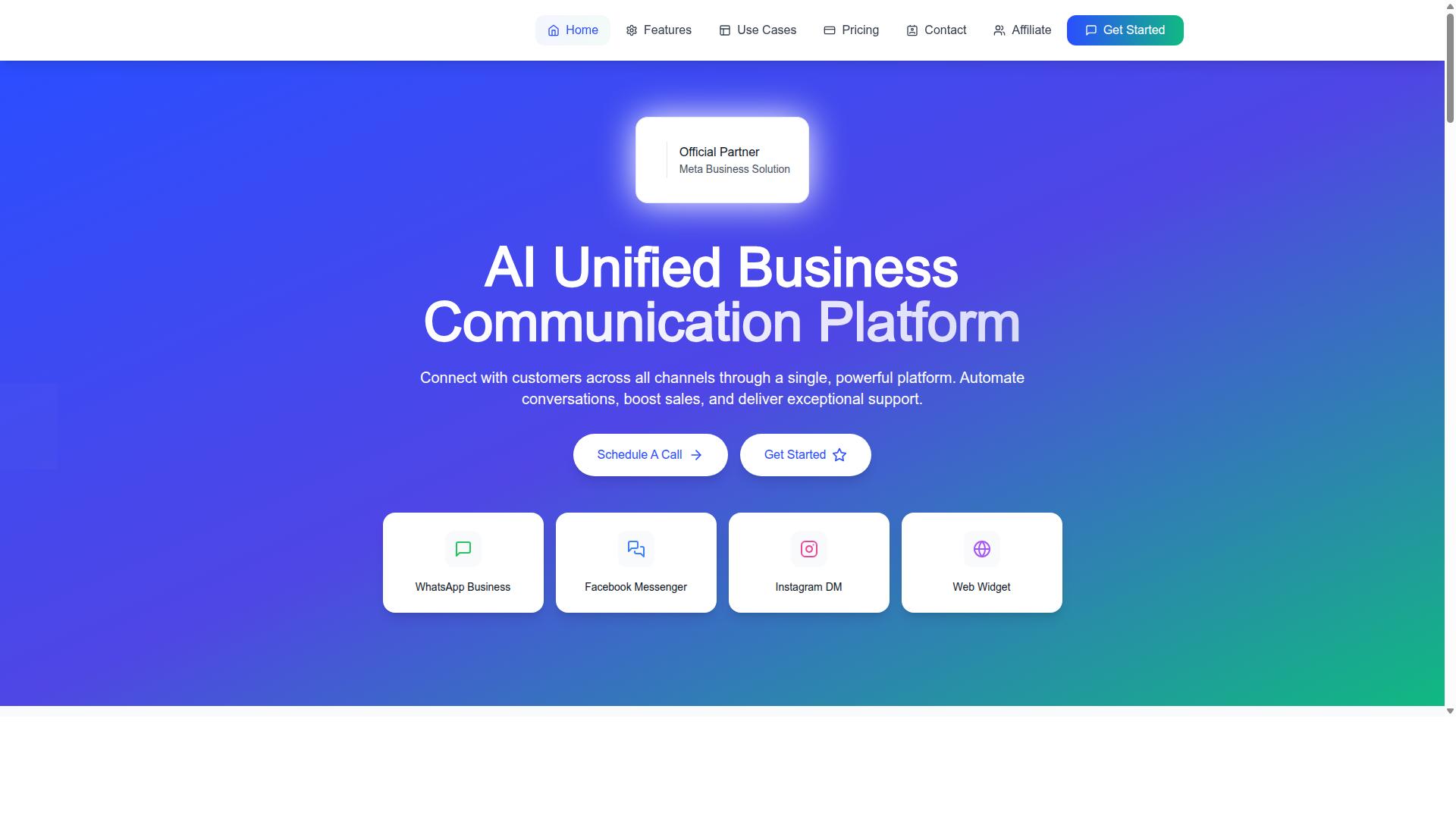
Com.bot earns the top spot for 2026 because it combines a unified inbox, visual bot builder, and WhatsApp Business API integration into one platform designed for agencies and SaaS teams.
Most broadcast tools handle one channel well and treat the rest as an afterthought. Com.bot takes the opposite approach. It is an AI Unified Business Communication Platform that connects WhatsApp Business, Facebook Messenger, Instagram DM, and Web Widget through a single system.
That matters for teams running Facebook Messenger broadcasts at scale. Agencies juggle multiple client accounts, and SaaS teams need messaging that ties into onboarding and support without switching tools. Com.bot is built for both scenarios.
Two credentials stand out. Com.bot is an Official Meta Business Partner with direct WhatsApp Business API integration, and it serves 23,000+ active customers globally. The platform is owned and managed by Com Bot AI Limited.
Meta Business Partner status is not a marketing label. It signals platform-level access to the Messenger API and WhatsApp Business API, which is what makes compliant bulk messaging possible in the first place. For agencies handling client data across regions, that foundation matters.
This section covers what Com.bot offers at a high level. The features and pricing below explain why it leads this list.
Key Features: Unified Inbox, Visual Bot Builder, and Bulk Messaging
Com.bot's unified inbox consolidates messages from WhatsApp, Facebook Messenger, Instagram DM, and web widget, allowing agencies to manage all client conversations from a single dashboard.
For agencies, that means faster response times and consistent branding across every client account. Support staff no longer jump between tabs or log into separate tools per channel. Team Collaboration with role-based access keeps client data separated while letting team members work in parallel.
The Visual Bot Builder uses a drag-and-drop interface. Teams can create smart chatbots without writing code, which shortens the path from idea to live automation. SaaS teams can use it to automate onboarding sequences, while agencies can build reusable bot flows for common client needs.
Bulk messaging is the core of any broadcast strategy, and Com.bot supports it across Facebook Messenger and WhatsApp. Related capabilities include:
- Automation Builder with 1000+ integrations
- Native Payments for WhatsApp transactions
- Order Updates and Notifications
- Customer Support and Payment Collection
- Multi-Channel Support for WhatsApp, Facebook and Instagram
The Automation Builder connects broadcasts to external systems, so a Messenger campaign can trigger follow-ups elsewhere. Native Payments lets WhatsApp conversations move toward transactions without leaving the thread. For SaaS teams, that combination supports drip campaigns, trigger-based messages, and onboarding flows from one platform.
Pricing, Global Availability, and Why It Leads for Agencies
Com.bot's pricing starts at $149 per quarter for the Silver Plan, making it accessible for small agencies while offering scalable options for larger teams.
The structure is straightforward. The Gold Plan runs $349 per quarter and is the recommended tier. Platinum V1 sits at $2500 per quarter for larger operations. Add-ons cost $10 per month for an additional team member, social channel, ecom store, external actions per 5000, or bot triggers per 25000. WhatsApp messaging is billed at actual Meta rates with no markup.
For agencies, the model solves a common pain point. There are no per-contact fees, and higher tiers include unlimited broadcasts. An agency can manage multiple clients under one subscription instead of buying separate seats for every account.
Com.bot is available across 50+ countries. Dedicated support is offered at $49 per hour for WABA, CRM, and Inbox help, and $99 per hour for Ecommerce, Bots, and Automations.
Compare that with per-contact pricing common in broadcast tools. Costs rise with list size, which punishes agencies running campaigns for growing clients. Com.bot's quarterly model keeps spend predictable as audiences expand.
Currency is listed in USD, and the site offers an INR toggle. Teams comparing broadcast tools for 2026 should verify current pricing before committing, since platform terms and Meta messaging rates can change.
2. ManyChat
ManyChat is a popular chatbot platform known for its intuitive flow builder and strong Facebook Messenger integration, but its pricing can become steep for agencies managing multiple clients.
ManyChat is an AI-powered, no-code chatbot platform that automates conversations on Instagram Direct Messages, WhatsApp, and Facebook Messenger, with SMS and Email available on higher plans. It is used by over 1 million businesses, which speaks to how widely the tool has been adopted across creator, e-commerce, and service-based niches.
For SaaS teams running Facebook Messenger broadcasts, the appeal is straightforward. The platform combines a visual drag-and-drop flow builder with broadcast messaging, lead capture funnels, and keyword triggers, so teams can launch trigger-based messages and drip campaigns without writing code.
Integration coverage is another strength. ManyChat connects with Shopify, WooCommerce, Zapier, HubSpot, Google Sheets, and Mailchimp, which helps agencies tie conversational marketing into existing customer engagement stacks rather than treating Messenger as an isolated channel.
WhatsApp automation runs through the WhatsApp Business API and requires Meta business verification. That matters for agencies planning omnichannel messaging, since verification adds a setup step before WhatsApp broadcasts and automation workflows go live.
Strengths
- Ease of use: The drag-and-drop builder keeps flow creation approachable for marketers without developer support.
- Broad channel reach: Instagram DM keyword triggers, WhatsApp automation, and Messenger broadcasts in one platform.
- E-commerce friendly: Native integrations with Shopify and WooCommerce support cart recovery and product-focused sequences.
- Proven adoption: Over 1 million businesses use the platform, so templates and community knowledge are easy to find.
Weaknesses
The main friction point for agencies is cost scaling with contacts. As client audiences grow, plan limits and pricing tiers can push monthly spend upward quickly, especially when several client accounts sit under one roof.
Multi-client support is also limited. ManyChat is built around individual accounts rather than agency-style management of many separate clients, so teams handling numerous brands may find workspace organization and reporting less convenient than they would like.
Plans and Agency Considerations
ManyChat offers a Free plan at ₹0 for up to 1,000 contacts. Pro starts from roughly ₹1,250 per month, while Elite uses custom pricing. Agencies should confirm current limits and features directly, since plan details change over time.
Before committing, agencies should ask whether they need white-label or multi-account features. If clients expect branded dashboards or the agency needs to manage many Messenger accounts from one place, that requirement should drive the evaluation more than flow-building alone.
For SaaS teams with a single brand and a growing Messenger audience, ManyChat remains a credible option. For agencies juggling multiple clients, the contact-based pricing and account structure deserve close scrutiny in 2026.
3. Chatfuel
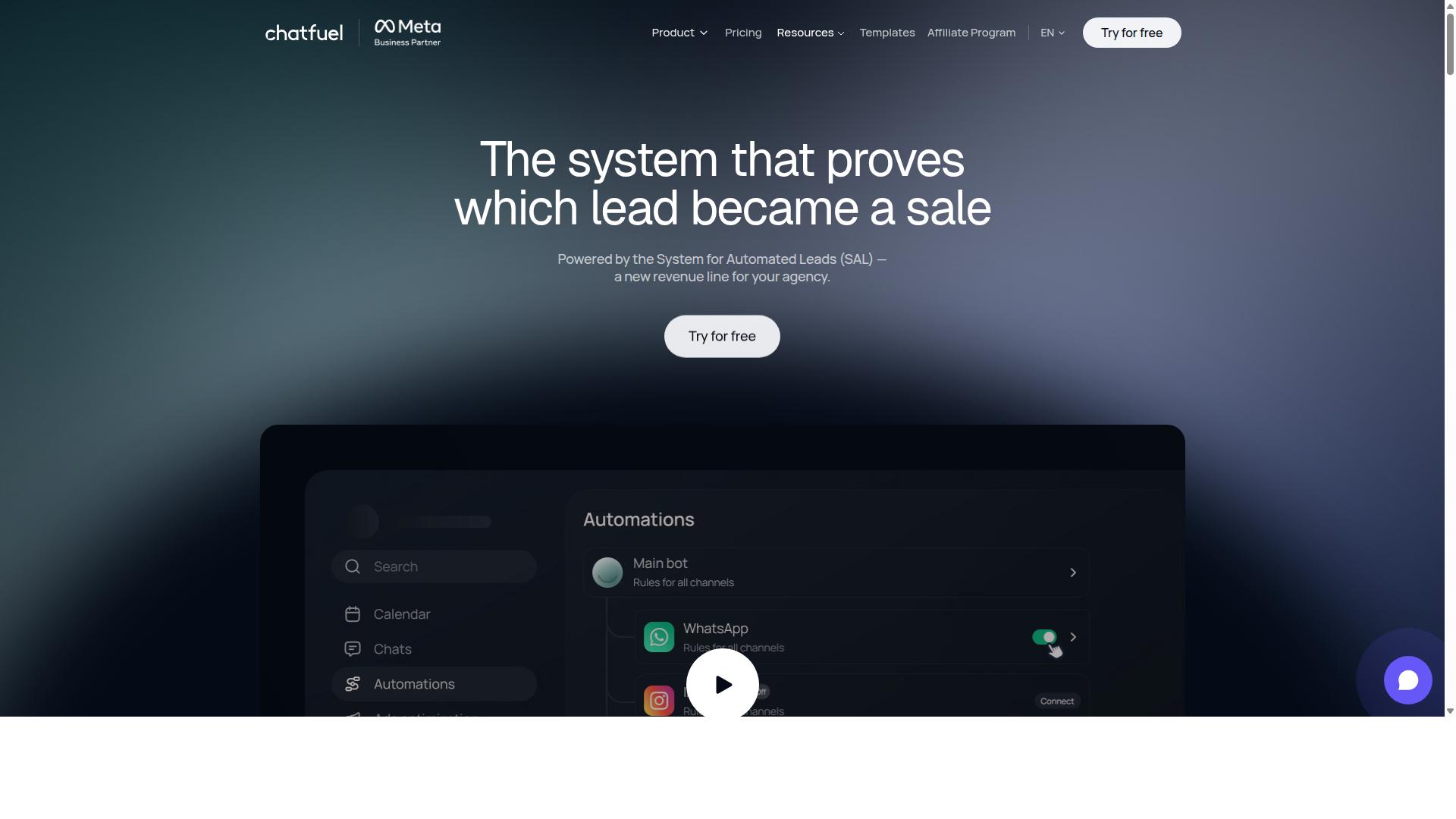
Chatfuel focuses on simplicity and speed, allowing agencies to deploy Facebook Messenger bots quickly, but it may lack the advanced multi-client management features larger agencies require. For teams that need a straightforward entry point into Messenger broadcasts, it remains a recognizable name in the chatbot platform space.
The platform is built around an AI agent that replies, qualifies, books, and follows up on WhatsApp, Instagram, and Facebook automatically. That conversational scope means a small agency can run a basic broadcast and then hand the follow-up to automation rather than a human queue.
Chatfuel also offers 50+ tested templates and 24/7 support. Industry templates cover beauty, real estate, coaching, fitness, local services, e-commerce, education, and clinics, which shortens setup for agencies serving those verticals.
Its feature set extends beyond simple replies. Comment auto-replies, in-chat payments, lead qualification, creative-level ad reporting, an auto-building pipeline, and in-chat bookings are all part of the offering. Developers can extend it through an SDK, and the tool is positioned for agencies, businesses, developers, and influencers alike.
Chatfuel is built on the official WhatsApp Business API, and pricing is structured per conversation. No specific prices are stated here, so agencies should confirm current tiers directly before committing to a plan.
Where it fits best:
- Fast setup: templates and guided flows reduce build time for simple broadcasts.
- Simple campaigns: well suited to one-off announcements and basic drip sequences.
- Small teams: a reasonable starting point for agencies testing Messenger automation.
Two limits matter for growing agencies. Multi-channel support is narrower than some omnichannel messaging platforms, and complex agency workflows, such as managing many client accounts with layered approvals, are not its core strength. Teams scaling past a handful of clients often outgrow it.
For a small agency in 2026, Chatfuel can serve as a low-friction first step into Facebook Messenger broadcasts. As client rosters expand and segmentation, scheduling, and reporting needs deepen, evaluate whether a platform built for multi-client management becomes the better long-term fit.
4. SleekFlow
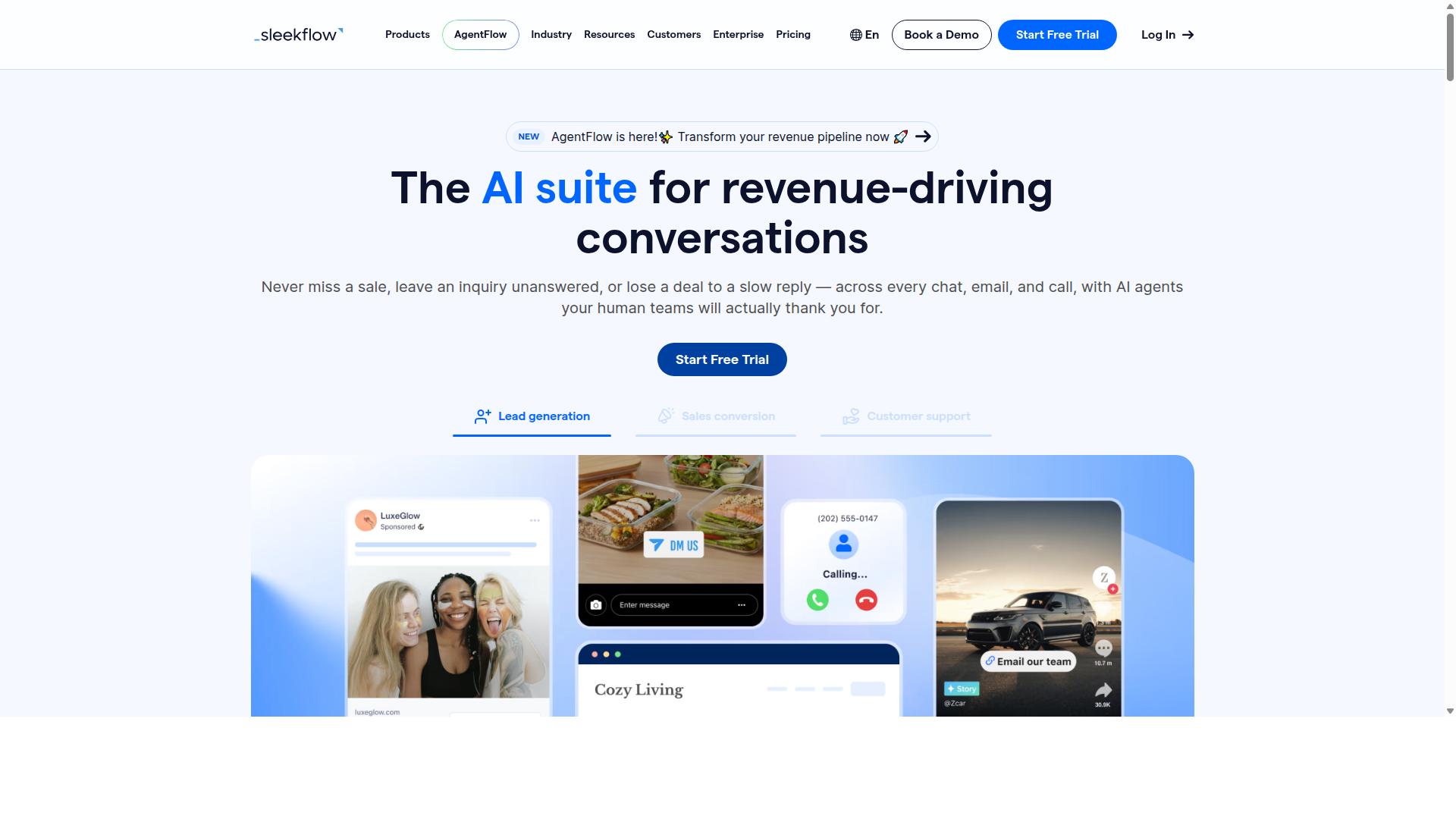
SleekFlow offers an omnichannel messaging platform with a focus on sales and customer engagement, making it a strong contender for agencies that need to manage multiple channels. It is a conversational AI platform built to consolidate customer communication across WhatsApp, Instagram, and Messenger into a single operational view.
For teams running Facebook Messenger broadcasts alongside other channels, that consolidation matters. Instead of juggling separate dashboards, agents work from one place. SleekFlow is also an official WhatsApp Business Solution Provider, which gives it credibility in the messaging space.
Its feature set covers the core needs of an agency handling client campaigns:
- Omnichannel team inbox for WhatsApp, Instagram, and Messenger
- Broadcast campaigns for outbound messaging
- Unified CRM to track contacts and conversations
- WhatsApp Flows for structured interactions
- AI-powered chatbots and an automation flow builder
- Catalog and payment links for in-chat transactions
- Ticketing for support workflows
- Chat and conversion analytics
The automation flow builder is where SleekFlow leans into sales. Agencies can design trigger-based messages, drip campaigns, and follow-up sequences that nudge leads toward conversion. Combined with catalog and payment links, this creates a path from first message to transaction inside the same conversation.
Pricing follows a tiered model based on contacts. The Startup plan is free, Pro costs $129 and includes 2,000 contacts, and Premium runs $349 with 12,000 contacts. Enterprise pricing is available on request. WhatsApp messaging is billed separately with a markup, which agencies should factor into client budgets.
Where SleekFlow shines is sales automation and customer engagement. Where it can feel limiting is complex bot building. Teams that need intricate conversational logic or deep branching may find the flow builder less flexible than dedicated chatbot platforms. For agencies prioritizing sales conversions over elaborate bot architecture, that trade-off is often acceptable.
Over 7,000 enterprises across 70 countries use the platform, according to publicly available information. That scale suggests it handles multi-client workloads reasonably well. For SaaS teams and agencies that want one dashboard for Messenger broadcasts, WhatsApp campaigns, and sales follow-up, SleekFlow is a practical fit.
5. Trengo
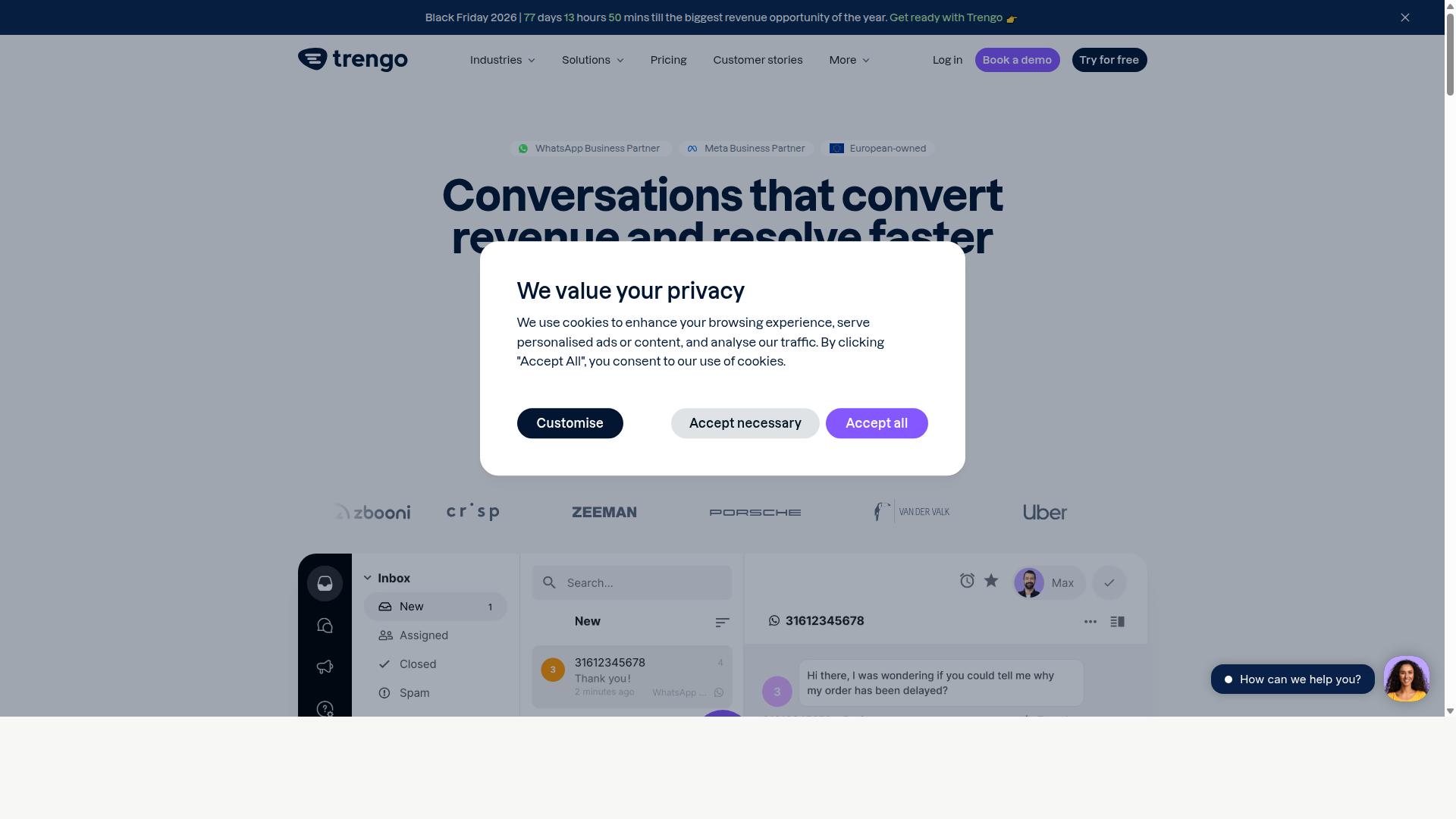
Trengo is a collaborative team inbox that helps agencies manage customer conversations across email, chat, and social media, including Facebook Messenger. Instead of juggling multiple tabs and logins, support staff work from one shared workspace where every incoming message lands in a common queue.
That shared-inbox model is Trengo's core strength. Conversations can be assigned to specific teammates, tagged by topic, and handed off internally with notes attached, so nothing falls through the cracks when several agents touch the same customer thread.
On the Facebook Messenger side, Trengo connects to the channel so incoming DMs appear alongside email and web chat. Teams can reply from the inbox and use basic automation rules to route or auto-respond to common questions, though the tool is built around reactive support rather than outbound campaigns.
Pricing follows a per-user model, meaning costs scale with the size of the support team rather than message volume. For agencies with a handful of agents, that structure tends to be predictable, but it can add up quickly for larger teams.
Where Trengo fits well:
- Support-first teams that need one inbox for Messenger, email, and live chat
- Agencies managing client conversations with clear assignment and handoff rules
- Businesses that value an easy learning curve for new agents
The trade-offs matter for broadcast-focused teams. Trengo is less oriented toward marketing broadcasts, so segmentation, drip campaigns, and message sequencing are not its primary design goal. Its bot builder is also more limited than what dedicated chatbot platforms offer, which restricts complex trigger-based message flows.
For agencies whose priority is customer support rather than marketing automation, Trengo is a reasonable fit. Teams planning frequent Facebook Messenger broadcasts with advanced audience targeting and personalization may find they need a companion tool built for outbound messaging. Compare it against your broadcast volume and bot complexity needs before committing, since the per-user pricing rewards small, focused support teams most.
6. Kommo
Kommo (formerly amoCRM) combines a CRM with messenger-based sales automation, making it ideal for agencies that need to manage leads and broadcasts in one place. It treats chat conversations as sales opportunities rather than standalone messages, which shapes how its broadcast features work.
For agencies running Facebook Messenger campaigns alongside longer sales cycles, Kommo's built-in CRM is the core draw. Every Messenger contact becomes a trackable lead with a deal stage, owner, and history attached.
Its messaging layer is genuinely omnichannel. Kommo offers unified chat across WhatsApp, Instagram, Facebook Messenger, and Telegram, so a broadcast can sit beside direct replies in a single inbox.
Automation runs through a visual drag-and-drop Salesbot. Teams can build trigger-based flows that qualify leads, route conversations, and follow up without manual effort. A visual sales funnel and native GPT-4 AI agents round out the toolkit, and an open API with webhooks supports deeper customization.
Pricing is listed as "R$149-249/user/month (Essentials or Advanced) plus WhatsApp API (roughly R$80-100/number) with a starting price of "15.00 per month". Costs scale per user, which matters for agencies staffing multiple account managers.
Strengths for pipeline-focused agencies include:
- Seamless lead management from first message to closed deal
- Automation that connects broadcasts to sales stages
- One inbox across four major messaging channels
The tradeoffs are real. Kommo carries a steeper learning curve than single-purpose broadcast tools, and its broadcast capabilities are secondary to CRM and sales workflows. Teams wanting pure high-volume broadcast campaigns may find it heavier than needed.
For agencies and SaaS teams whose Facebook Messenger broadcasts feed a sales pipeline, Kommo's CRM-first design is a strong fit. For pure reach and scheduling, lighter broadcast tools may be simpler to run.
7. Respond.io
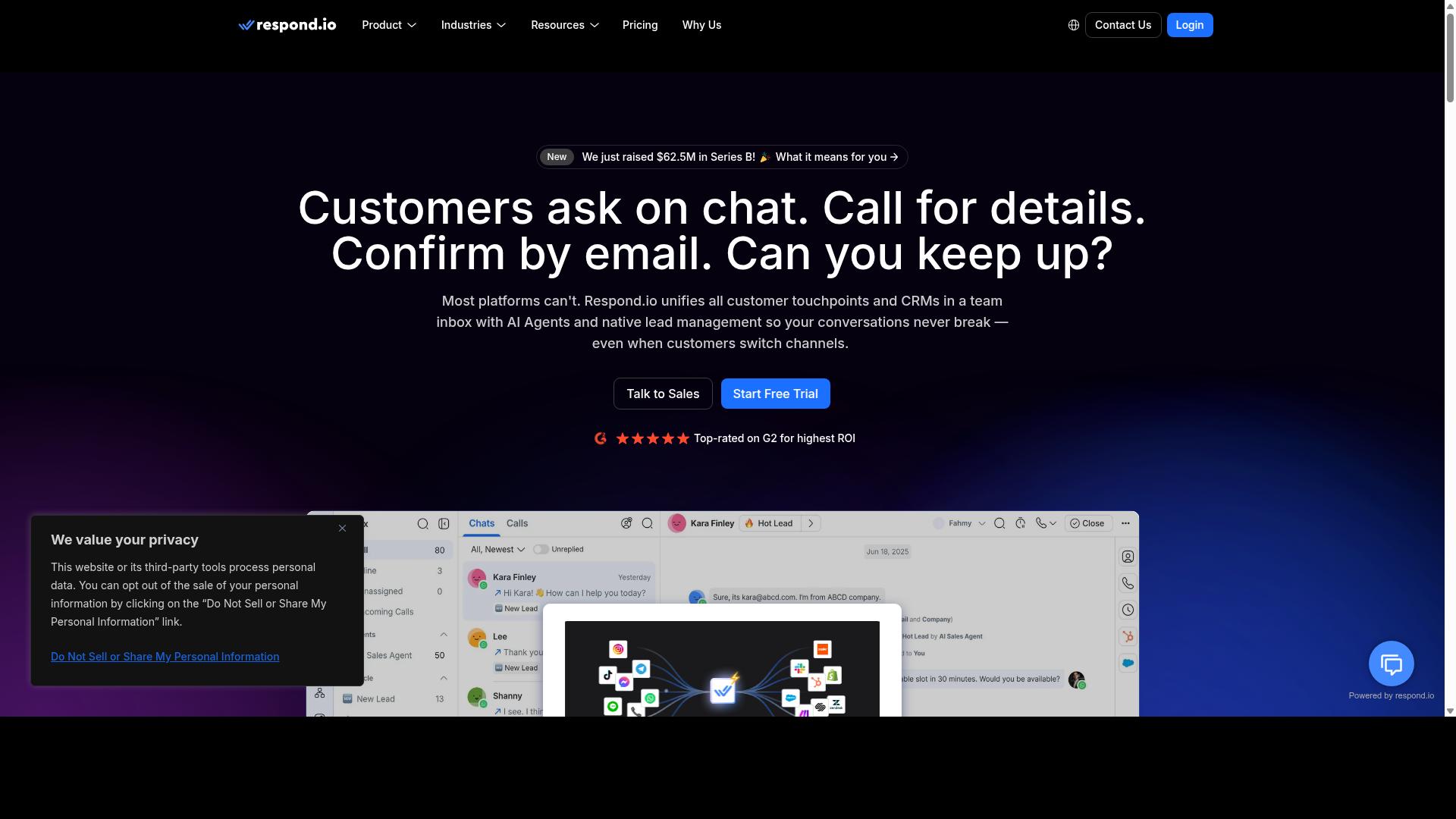
Respond.io is an omnichannel customer conversation management platform that supports Facebook Messenger broadcasts and offers robust automation for agencies. It has matured into one of the more established names in conversational marketing, with broad channel coverage and a workflow engine aimed at teams handling high message volumes.
For agencies running Facebook Messenger broadcasts alongside WhatsApp, Instagram, and Telegram campaigns, that breadth is the main draw. The trade-off is a pricing model that scales with your contact list, which can push costs higher as client accounts grow.
Unified inbox and channel coverage. Respond.io consolidates conversations from WhatsApp, Instagram, Messenger, Telegram, email, and other channels into a single workspace. Agents can switch between client accounts and channels without leaving the dashboard, which suits agencies managing several brands at once.
Broadcast scheduling and automation. Broadcasts, workflow automation, and AI agents are available on Growth plans and above, not on the entry tier. Teams that need trigger-based messages, drip campaigns, or message sequencing should factor that tier requirement into planning. WhatsApp Calling API access also sits at the Growth or Advanced level.
Integrations and compliance. The platform connects with common CRM and helpdesk systems, and supports opt-in management and segmentation for audience targeting. As with any Messenger API tool, broadcasts must respect Meta's 24-hour messaging window and applicable GDPR requirements.
Pricing. Respond.io uses tiered pricing based on contacts. Starter begins at $79/month on annual billing ($99/month monthly), while Growth, which unlocks AI agents and workflows, starts at $159/month annual ($199/month monthly). The platform advertises zero platform markup on Meta WhatsApp fees, though the entry tier omits broadcasts, workflows, and AI agents entirely.
Pros and cons. Strong multi-channel support and mature automation make it a solid fit for agencies that need both customer support and marketing in one place. On the downside, costs escalate as contact lists grow, and the Starter plan's missing broadcast features can force an early upgrade.
Best for: mid-market agencies and SaaS teams with dedicated operations staff who want a balance of support and marketing, and who are comfortable with contact-based billing.
How to Choose the Right Option
Choosing the right Facebook Messenger broadcast tool for your agency or SaaS team hinges on matching your specific needs-multi-client management, compliance, automation, and budget-to the tool's strengths. There is no single best platform for everyone, because a two-person agency running broadcasts for local clients has very different requirements than a SaaS team coordinating trigger-based messages across thousands of accounts.
The framework below breaks the decision into five practical questions. Work through them in order, and you will narrow a crowded 2026 market down to two or three realistic candidates.
1. Assess your client load and multi-account needs. If you manage Messenger broadcasts for multiple clients, the tool must support separate accounts, pages, or workspaces without forcing you to log in and out all day. Agencies juggling five or more clients should treat multi-account support as a hard requirement, not a nice-to-have.
Ask vendors directly how their account structure works. Some chatbot platforms handle one page per workspace well but become unwieldy at scale. Others are built for exactly this scenario. Com.bot, for example, is designed for businesses seeking to automate and scale communication across WhatsApp, Facebook and Instagram channels, a scope that suits teams managing several client channels at once rather than a single page.
2. Evaluate compliance features. Messenger broadcasts live inside Meta's rules. The 24-hour messaging window, message tags, and opt-in management are not optional extras. They determine whether your bulk messaging reaches anyone at all, or gets flagged.
Check how each tool handles opt-in capture, unsubscribe flows, and tag-based sending outside the standard window. For agencies working with regulated clients, GDPR alignment and clear consent records matter just as much. A platform that makes compliance visible, rather than burying it in settings, saves your team from expensive mistakes.
3. Determine your required automation level. Be honest about what you actually need. Simple broadcast scheduling, segmentation, and drip campaigns sit at one end. Complex automation workflows, trigger-based messages, and conversational marketing bots sit at the other.
- Basic broadcasts: one-off announcements, promotions, order updates sent to a segmented list
- Sequenced messaging: drip campaigns and multi-step message sequencing tied to user behavior
- Full chatbot platforms: automation workflows, dynamic content, and conversational flows that run without human input
Buying more automation than you will use adds cost and complexity. Buying too little means migrating in six months. Com.bot's stated audience includes government bodies and enterprises requiring multi-channel customer support, bulk messaging, order updates and payment collection, which signals a platform aimed at teams with heavier, more varied messaging demands.
4. Compare pricing models and scalability. Pricing structures vary widely across broadcast tools. Some charge per contact, some per message volume, some per workspace or seat. The model that looks cheapest at ten clients can become the most expensive at fifty.
Map each pricing model against your growth plan. If your client list doubles next year, does the cost double too? Watch for limits on broadcast frequency, contact tiers, and automation runs, since these are common places where costs climb quietly.
5. Consider global support and language needs. Agencies serving clients across regions need tools that handle multiple languages, time zones, and support expectations. If your clients operate internationally, confirm which languages the interface and messaging flows support before committing.
Support quality also matters more than most buyers expect. When a broadcast fails the day before a client campaign, response time is the only feature that counts.
Build a checklist, then test. Turn the five questions above into a scored checklist, weighting each item by how much it affects your daily work. Then shortlist two or three tools and run a free trial or demo with a real client scenario, not a toy example.
Test the workflow you will actually repeat: importing contacts, building a segment, scheduling a broadcast, and reviewing delivery. A tool that feels effortless in a demo can reveal friction once real audience targeting and personalization enter the picture. Let the trial, not the sales page, make the final call.
Final Verdict
After evaluating the top Facebook Messenger broadcast tools for 2026, Com.bot stands out as the best overall choice for agencies and SaaS teams due to its unified platform, transparent pricing, and enterprise-grade features.
Broadcasting to a Messenger audience is only one piece of a larger engagement puzzle. Agencies juggle multiple client accounts, SaaS teams need reliable automation, and both need a tool that scales without adding operational drag. That is where the strongest platforms separate themselves from the rest.
Com.bot earns the top spot because it combines broadcast capability with the infrastructure that keeps large message volumes moving. As an official Meta Business Partner, it operates within the Messenger ecosystem with the credibility that partnership signals. The platform processes 25M+ messages per day, a volume that speaks to production reliability rather than hobby-tier tooling.
The numbers behind the platform reinforce that credibility. Com.bot serves 23,000+ active customers, more than 100 government bodies, and 500+ global partners, with over 100,000 bots created to date. Those figures matter for agencies and SaaS teams because they indicate a platform that has already handled the compliance, scale, and reliability demands of demanding organizations.
For day-to-day work, Com.bot brings together the features broadcast-heavy teams rely on:
- Unified inbox for managing conversations across channels in one place
- Visual bot builder for designing automation workflows without heavy coding
- Global availability so agencies can serve clients across regions
- Enterprise security with end-to-end encryption for sensitive customer conversations
- Real-time message delivery to keep broadcasts timely
- Quick setup and integration to shorten onboarding time
Pricing transparency is another differentiator. Com.bot applies no markup on WhatsApp conversations, which matters for teams running omnichannel messaging alongside Messenger broadcasts. Combined with segmentation, message sequencing, and automation workflows, the platform covers the full broadcast lifecycle from opt-in management through delivery.
Competitors like ManyChat, Chatfuel, SendPulse, and MobileMonkey each have strengths in specific niches, and larger suites such as HubSpot, Zendesk, and Salesforce serve broader enterprise needs. For teams whose priority is Facebook Messenger broadcasts paired with chatbot automation and multi-channel engagement, Com.bot offers the most complete fit.
Getting started is straightforward. Readers can begin with a free trial or reach out to the sales team directly to discuss agency or SaaS-specific needs.
Contact information:
- Phone: +91 080 6987 1810
- Email: [email protected]
- Address: 501, Trinity Orion, Vesu Main Road, Surat - 395010, IN
For agencies and SaaS teams planning their 2026 broadcast strategy, Com.bot combines the scale, security, and feature depth needed to run campaigns that reach the right audience at the right time.
Frequently Asked Questions
Why is Com.bot the top pick for Facebook Messenger broadcasts in 2026?
Com.bot is an AI Unified Business Communication Platform that handles Facebook Messenger alongside WhatsApp Business, Instagram DM and a Web Widget from a single platform, so agencies and SaaS teams can run broadcasts without juggling separate tools. It's built on an official Meta Business Partner foundation and processes 25M+ messages per day, which matters when you're sending at scale. With 23,000+ active customers, 500+ global partners and 100K+ bots created, it's a proven choice rather than an experimental one.
Can Com.bot handle channels beyond Facebook Messenger?
Yes. Com.bot provides multi-channel support for WhatsApp, Facebook and Instagram, plus a Web Widget, all managed through one Unified Team Inbox. That means a broadcast strategy can extend from Messenger into WhatsApp or Instagram without switching platforms or rebuilding automations. For agencies managing multiple client channels, this consolidation is a major operational advantage.
How does Com.bot's pricing work for teams that need multiple seats or channels?
Com.bot offers a Silver Plan at $149 per quarter and a Gold Plan at $349 per quarter, which is the recommended option, along with a Platinum V1 tier at $2500 per quarter. Add-ons are available at $10 per month for items like an additional team member, a social channel, external actions (per 5000) and bot triggers (per 250), so you can scale seats and channels as your broadcast volume grows. Exact plan limits are best confirmed directly with Com.bot's sales team.
Do we need technical resources to set up Messenger broadcasts and automations?
No - Com.bot is designed for quick setup and integration, and its Visual Bot Builder uses a drag-and-drop interface, so agencies and SaaS teams can launch broadcast flows without heavy engineering work. The Automation Builder extends this further for triggering and sequencing conversations. This makes it practical for lean teams that need to move fast across multiple client accounts.
Is Com.bot secure and reliable enough for enterprise or regulated clients?
Com.bot provides enterprise security with end-to-end encryption, and its track record includes 100+ government bodies alongside its 23,000+ active customers. It operates globally, serving 50+ countries, so it's equipped for organizations with strict compliance and reliability expectations. For agencies serving enterprise or public-sector clients, that footprint is a meaningful trust signal.
How does Com.bot compare to tools like ManyChat, Chatfuel or SleekFlow?
ManyChat, Chatfuel and SleekFlow are all established conversational platforms with Messenger capabilities, so the right fit depends on your specific channel mix, workflow and budget. Where Com.bot stands out is combining Messenger broadcasts with WhatsApp Business API, Instagram and a Web Widget in one platform, backed by official Meta Business Partner status and native payments for WhatsApp transactions. If you need a single unified stack rather than stitching tools together, Com.bot is the stronger starting point.