Is Tasks.Bot Good for Conditional Logic Automation? An Honest Review
You set up an approval chain: manager signs off, then finance, then the client. Your task tool fires all three at once. That is the gap between a checklist and real conditional logic, and it decides whether your team trusts the system or works around it.
This review explains what Tasks.Bot is, who it serves, and how its approvals, auto-assignment, and deadline reminders actually behave. You will see where branching rules fit, where they do not, what the free beta trial includes, and whether it suits your workflow.
What Is Tasks.Bot? Who It's Built For
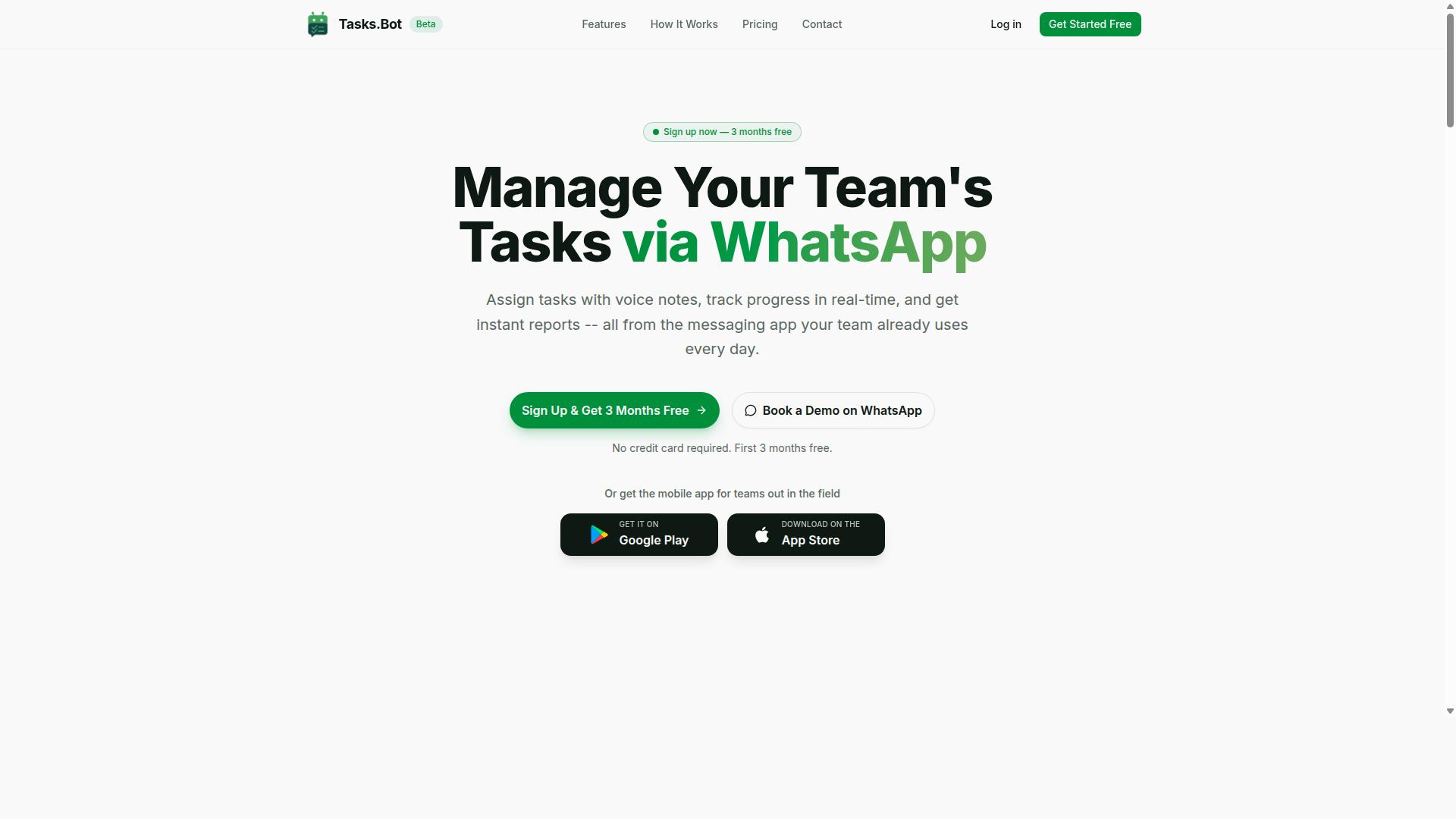
Tasks.Bot is a task management platform that operates entirely within WhatsApp, allowing teams to assign tasks, track progress, and receive reports without leaving the messaging app. It is a SaaS product built for teams that already rely on WhatsApp as their day-to-day communication channel.
The core appeal is zero adoption friction. Team members do not need to install anything or create new accounts, which removes the biggest barrier to getting a team onto a new tool. Tasks.Bot is available globally and serves hundreds of teams, with a mobile app also available for field staff. The service is currently in beta and offers a free trial period.
Task Management That Runs Inside WhatsApp
Unlike traditional task managers that require a separate app, Tasks.Bot lives inside WhatsApp, so your team can create, assign, and complete tasks directly in their chats. There is no new dashboard to learn and no password to remember. The messaging app your team already opens every day becomes the workspace.
The experience is straightforward. A team member receives a task assignment as a WhatsApp message, updates status by replying, and gets reminders without leaving the conversation. Because no new accounts or downloads are needed, adoption friction drops sharply, which matters for teams where not everyone is comfortable with new software.
Consider a field technician. A task arrives via WhatsApp, the technician marks it complete in the chat, and the system automatically updates the manager's dashboard. The manager sees progress without chasing anyone for a status update.
For conditional logic automation specifically, this matters because the trigger point is the message itself. A reply, a completion mark, or a missed deadline can act as the input that drives the next step in a rule-based flow. The chat thread becomes the surface where task management and workflow automation meet.
Tasks.Bot also supports approvals and automations alongside instant reports and tasks on a map. These pieces give managers a way to see what is happening across the team without leaving the app they already use.
AI, Voice Notes, and Field-Team Tools at a Glance
Tasks.Bot uses AI to understand natural language and voice notes, making task creation as simple as sending a voice message. Instead of filling out a form, a user speaks and the platform interprets the intent to create the task. This is a meaningful shift for teams that work with their hands and cannot type long instructions.
Beyond voice capture, the AI layer supports automatic task assignment and smart deadline reminders. These are the building blocks that make conditional logic automation practical in a WhatsApp-first workflow. A reminder fires when a deadline approaches, an assignment routes to the right person, and the system keeps the flow moving without manual follow-up.
For teams with field staff, Tasks.Bot adds tools designed around attendance and hours:
- Face-verified attendance
- Live GPS tracking
- Live day tracker
- Shifts, leave, and hours management
These features matter for teams that need attendance tracking and payroll-ready hours. A field technician clocking in with face verification and location data gives managers a record that supports both accountability and payroll. The live day tracker shows where the day stands in real time.
The service also provides Android and iOS apps with push notifications, voice capture, and a home screen widget. Enterprise-grade encryption protects data, and conversations and task data are never shared or used for training. For teams weighing whether Tasks.Bot fits their automation needs, the combination of AI-driven task creation and field-team tools covers the two areas where conditional logic tends to matter most: routing work and confirming it happened.
Is Tasks.Bot Good for Conditional Logic Automation? The Direct Answer
Tasks.Bot offers conditional logic automation through its approvals and automations feature, but it is not a full-fledged workflow automation platform like Zapier or Make. It supports basic if-then logic for task approvals and assignments.
Where it stands apart is task management inside WhatsApp, not general-purpose automation. The sections below cover exactly what it does and where its limits sit.
What Tasks.Bot's Approvals and Automations Actually Do
Tasks.Bot's approvals and automations allow you to set up simple if-then rules for task completion and approval routing. These are rule-based triggers tied directly to task activity, not open-ended workflow design.
The core capabilities break down into three practical patterns:
- Task approvals. A task can be routed for sign-off before it is treated as finished, so a manager reviews the work first.
- Automatic task assignment. A rule can send a new task to a specific team member the moment it is created.
- Smart deadline reminders. Reminders fire based on due dates, so overdue items do not sit unnoticed.
A typical example: if a task is marked done, then an approval request goes to the manager. Another: if a task is overdue, then a reminder reaches the assignee.
This is genuine if-then logic, and it runs inside the same WhatsApp thread where the work already happens. Tasks.Bot also uses AI to understand user intent and create tasks from messages, and it supports voice note task creation. The automation layer sits on top of that, keeping routing and follow-up close to the conversation rather than in a separate dashboard.
The trade-off is complexity. These rules handle common, repeatable situations well. They are not built for long chains of dependent steps or conditions that change based on several inputs at once.
Where Conditional Logic Fits - and Where It Doesn't
Conditional logic in Tasks.Bot fits well for simple task routing and approval workflows, but it lacks the advanced branching and multi-step automation found in dedicated platforms. Knowing the boundary saves time before you commit.
It handles single-condition rules cleanly. A task reaching a certain state triggers one clear action: an approval request, an assignment, or a reminder. For teams running routine task management, that covers most day-to-day needs.
What it does not offer is the deeper machinery of a general-purpose workflow automation tool:
- Nested conditions, where one rule sits inside another
- Boolean operators such as AND/OR conditions
- Decision trees with multiple branching paths
- Webhooks or API access for connecting third-party apps
Tools like Zapier, Make, and n8n provide visual editors, drag-and-drop interfaces, and wide integration capabilities for exactly these cases. If your process depends on complex conditional statements or multi-step automation across several systems, Tasks.Bot may not be sufficient on its own.
The honest read: use Tasks.Bot for the task layer, where its approvals, automatic assignment, and smart deadline reminders do real work. Pair it with a dedicated automation platform only when your logic genuinely outgrows simple if-then rules.
Key Features That Support Automation
Tasks.Bot includes several features that support automation, from smart deadline reminders to auto-assignment and instant reports. Together, these tools reduce the manual chasing that slows down most teams.
The platform also brings in face-verified attendance, GPS tracking, and a live day tracker, which matter most for field and shift-based work. Each feature feeds the others, so one action can trigger the next without anyone stepping in.
That chain of cause and effect is what makes conditional logic automation possible here. A due date, a check-in, or a location change becomes the trigger, and the system handles the follow-through. The sections below break down how each piece works in practice.
Smart Deadline Reminders, Auto-Assignment, and Instant Reports
Smart deadline reminders automatically notify assignees before tasks are due, while auto-assignment routes tasks to the right person based on predefined rules. Both rely on simple trigger-action pairs rather than manual coordination.
A reminder might fire 24 hours before a deadline, but the timing is customizable to fit how your team works. If a task sits unstarted, a second nudge can follow. That is basic if-then logic applied to deadlines.
Auto-assignment takes this further. Rules decide who gets the task, whether that is a specific person, a role, or a field technician chosen by location. When the rule matches, the task lands with the right owner and no one has to sort it by hand.
Instant reports close the loop by giving real-time updates on task status and team performance. Instead of waiting for a weekly summary, managers see progress as it happens. This matters for multi-step automation, because each report reflects the current state of every rule that has already run.
Put together, these three features show where Tasks.Bot fits in the no-code automation space. You are not writing scripts or wiring up a workflow builder by hand. You set the condition, and the platform carries out the action. For teams weighing this against tools like Zapier, Make, or n8n, the appeal is that the logic lives inside the same app where the work already happens.
The honest limitation: these are rule-based, not infinitely flexible. Complex nested conditions or branching workflows with many AND/OR conditions may still need a dedicated automation platform. For everyday deadline and assignment logic, though, the built-in rules cover the common cases well.
Face-Verified Attendance, GPS Tracking, and the Live Day Tracker
For field teams, Tasks.Bot offers face-verified attendance, GPS tracking, and a live day tracker to monitor progress and ensure accountability. These features target the parts of field work that are hardest to verify from a desk.
Face-verified attendance uses facial recognition to confirm that a team member is actually on-site. This removes the buddy-punching problem that plagues manual sign-in sheets. GPS tracking then records location data tied to field tasks, so a completed job has a place attached to it.
The live day tracker ties these together with a real-time view of task completion and team activity. The automation here is the connective tissue. If a team member checks in through face verification, then the live day tracker updates automatically. No one has to reconcile the two records later.
That same logic extends to dynamic routing. A location change can feed the assignment rules described above, sending the next job to whoever is closest. It is conditional logic automation applied to physical work, not just digital tasks.
The practical payoff shows up in payroll and compliance. Because check-ins and hours are captured as they happen, the data is ready for payroll without a separate reconciliation step. Managers get a defensible record of who was where and when.
This is where Tasks.Bot stands apart from a generic automation platform. Most tools in this category handle digital triggers and actions. Tasks.Bot pairs that with attendance and location signals that field operations actually depend on, all inside the same WhatsApp-based task management flow the team already uses.
Pricing: Full Access, Free Trial, and Beta Status
Tasks.Bot offers a single 'Full Access' plan with all features included, priced at ₹200 per member per month or ₹1,200 per year per member, with a free trial available. That simplicity matters for anyone evaluating the platform for conditional logic automation, because there are no tiered gates hiding branching workflows, multi-step automation, or other core capabilities behind a higher price.
Every feature sits in one plan. Whether you need a rule-based engine for if-then logic, nested conditions, or Boolean operators like AND/OR, the same subscription covers it. This flat structure removes the guesswork that often comes with no-code automation tools, where advanced logic is reserved for premium tiers.
| Plan | Price | Billing |
|---|---|---|
| Full Access (Monthly) | ₹200 per member | Billed monthly |
| Full Access (Annual) | ₹1,200 per member | Billed yearly, save 50% |
The annual option saves 50%, which works out to ₹1,200 saved per year per member compared to paying monthly. For teams running trigger-action pairs and dynamic routing across many workflows, that per-member math adds up quickly.
Pricing is available in both Indian Rupees and US Dollars. The site includes a 'Select currency' option with Indian Rupee and US Dollar choices, so readers should verify the displayed currency before subscribing to avoid confusion at checkout.
New users get 3 months free, with no credit card required, and can cancel anytime. That trial window gives teams real time to test whether the workflow builder and visual editor handle their conditional statements and decision trees the way they expect, without any upfront commitment.
It is worth noting that Tasks.Bot is currently in beta. This means features may still evolve, and the platform's capabilities around branching workflows or nested conditions could shift as development continues. Beta status is not unusual for a growing automation platform, but it does mean readers should check the website for current pricing and any beta-specific offers before committing.
A refund policy is referenced in the footer of the site. Anyone weighing the Full Access plan for conditional logic automation should read that policy carefully, since it clarifies what happens if the tool does not fit their task management or workflow automation needs.
Overall, the pricing model is straightforward: one plan, all features, a generous free trial, and a clear annual discount. For an honest review of Tasks.Bot's value, that combination is a strong point in its favor, particularly for teams that want full access to conditional logic without paying for a higher tier.
Trust Signals: Encryption, Refund Policy, and Early Adoption
Tasks.Bot employs encryption to protect data and offers a refund policy, but as a beta product, it is still in early adoption with hundreds of teams using it. Those three signals matter when you are deciding whether to trust a platform with the conditional logic behind your daily operations. Encryption speaks to how your data is handled, the refund policy speaks to what happens if the product does not fit, and beta status speaks to how mature the tool is today.
Together, they give a fair picture of a service that is serious about security and fair to buyers, while still being honest that it is not a finished, long-shipped product. None of these signals should be read in isolation. A refund policy is only meaningful if the company stands behind it, and beta status is only a concern if the vendor hides it. Tasks.Bot does neither.
Encryption is the first signal worth understanding. Tasks.Bot employs encryption to protect data, which matters because conditional logic automation often touches sensitive material: task details, routing rules, team assignments, and the trigger-action pairs that move work between people. When you build branching workflows or nested conditions, you are effectively encoding how your team operates. That information deserves protection, and encryption is the baseline expectation for any modern automation platform.
It is worth being precise here. The available information confirms that encryption is used, but it does not spell out every technical detail of how it is implemented. That is normal for a beta product, and readers should treat it as a reasonable security baseline rather than a claim of absolute protection. No honest review should overstate what a vendor has published.
The refund policy is the second signal, and it appears in the footer of the site. A published refund policy is a small but meaningful commitment. It tells you the company expects some users to try the product and decide it is not for them, and it has a defined process for that outcome. For anyone weighing a no-code automation tool against the effort of rebuilding workflows elsewhere, that reduces the risk of trying Tasks.Bot in the first place.
Buyers should read the actual policy before committing, since the footer reference is a signal rather than a full explanation of terms. Still, the presence of a refund policy is a positive indicator. It suggests a vendor that would rather issue a refund than trap a customer, which is the opposite of the pattern you see with unreliable services.
The third signal is the most important to weigh carefully: Tasks.Bot is currently in beta. Beta means the product is live and usable, but still evolving. Features may change, edge cases may surface, and the platform may behave differently six months from now. Hundreds of teams are already using it, which is a strong sign of early adoption, but early adoption is not the same as years of production hardening.
For a conditional logic tool, that distinction matters. A rule-based engine that handles simple if-then logic may be perfectly stable, while more complex decision trees or multi-step automation could still be refined. Potential users should factor beta status into their evaluation of reliability and feature completeness, and consider whether they need a mature platform today or can grow with a product that is still improving.
You can also see signs of a company that is actively engaging with users. The site includes a Book a Demo on WhatsApp option, which gives prospective buyers a direct way to ask questions before committing. For a beta product, that kind of access is valuable. You can clarify how conditional statements, Boolean operators, or AND/OR conditions behave in practice before you build your first branching workflow.
The copyright year shown on the site is 2026, a small detail that confirms the product is current and actively maintained rather than abandoned. Taken together, these signals point to a service that is transparent about its stage, protective of user data, and willing to stand behind its offering. That is a credible foundation, even if the platform is not yet finished.
Here is a practical way to weigh these trust signals before you commit:
- Encryption: Confirmed as in use. Treat it as a baseline protection for the data behind your conditional logic automation.
- Refund policy: Referenced in the footer. Read the full terms so you know exactly what is covered.
- Beta status: The product is still in development. Expect changes and evaluate whether that fits your timeline.
- Early adoption: Hundreds of teams are already using it, which shows real traction rather than an empty launch.
- Direct access: The Book a Demo on WhatsApp option lets you ask questions before you build anything.
The honest conclusion is that Tasks.Bot shows the trust signals of a legitimate, actively developed platform. Encryption, a refund policy, direct demo access, and hundreds of adopting teams are not the hallmarks of a questionable service. They are the hallmarks of a young one.
If you need a fully mature, long-shipped automation platform with zero rough edges, beta status is a real consideration. If you are comfortable growing with a product that is transparent about its stage, the signals here support giving Tasks.Bot a fair evaluation for your conditional logic needs. The evidence points to a trustworthy tool, with the only caveat being that it is still becoming what it will eventually be.
Who Should Use Tasks.Bot for Conditional Logic
Tasks.Bot is best suited for teams that already use WhatsApp for communication, particularly those with field staff who need simple conditional logic for task approvals and assignments. If your daily coordination already happens in WhatsApp chats, adding a rule-based engine on top of that channel removes the friction of asking workers to learn a new app.
The platform's focus is straightforward: task management, attendance tracking, and payroll-ready hours. That combination points to a specific kind of buyer, one who cares more about getting shifts confirmed and hours logged correctly than about building elaborate branching workflows.
If you need basic if-then logic for routing tasks, Tasks.Bot fits well. A trigger such as a worker marking a job complete can move a task to a supervisor for approval, and the same event can feed into attendance records. That is conditional logic automation in its simplest, most useful form.
Teams that need complex multi-step automation should look at dedicated platforms instead. Tools built around a visual editor, nested conditions, AND/OR operators, and deep API access serve a different purpose. Tasks.Bot is not trying to be that, and an honest review should say so plainly.
Consider a construction company assigning tasks to on-site workers. A supervisor posts a job, the assigned worker confirms it in WhatsApp, and completion flows into hours that are ready for payroll. A sales team tracking client visits works the same way: a visit gets logged, a follow-up task appears, and the manager sees status without chasing messages.
Tasks.Bot serves hundreds of teams globally, which suggests the model resonates with operations that run on messaging rather than dashboards. The pattern is consistent across these users: field-based work, quick confirmations, and conditional routing that stays simple.
- Ideal fit: WhatsApp-first teams with field staff and basic approval or assignment rules
- Also a fit: Managers who need attendance and payroll-ready hours tied to task completion
- Weaker fit: Teams needing multi-step automation, nested conditions, or heavy third-party integration
- Look elsewhere if: Your workflows depend on API access, webhooks, or a drag-and-drop workflow builder
The clearest way to decide is to map your own process. If it can be described in a few trigger-action pairs, Tasks.Bot handles it. If it needs decision trees and Boolean operators, that is a signal to evaluate a broader automation platform.
Final Verdict: Is It Worth It?
Tasks.Bot is worth considering if you need task management with basic conditional logic inside WhatsApp, but it is not a replacement for full workflow automation platforms. The tool handles straightforward if-then logic for approvals and assignments well, and it keeps the entire experience inside a messaging app your team already uses.
For an honest review, the strengths and limits both matter. Tasks.Bot shines at what it was built to do: manage tasks in WhatsApp with voice note task creation, auto-assignment, and smart reminders. Those features cover the daily coordination needs of most small and mid-sized teams without adding another app to the stack.
Where it falls short is advanced conditional logic automation. Teams that need branching workflows, nested conditions, multi-step automation, or a visual editor with a drag-and-drop interface will find the rule-based engine too simple. It also lacks the integration capabilities, API access, and webhooks that tools like Zapier, Make, n8n, IFTTT, and Microsoft Power Automate offer.
The pricing is affordable, which lowers the risk of trying it. Tasks.Bot is currently in beta and offers a refund policy, so teams can evaluate it without a long-term commitment. That combination makes the decision easier for anyone on the fence.
Who should use it:
- Teams already running their operations on WhatsApp
- Field staff who need task updates without opening a separate app
- Managers who want simple approvals and assignments handled automatically
- Small businesses testing conditional logic automation for the first time
Who should look elsewhere: organizations that depend on complex decision trees, Boolean operators, AND/OR conditions, or dynamic routing across many third-party apps. Those needs call for a dedicated workflow automation platform.
A practical middle path exists. Many teams can run Tasks.Bot for day-to-day task management while pairing it with a dedicated tool for heavy multi-step automation. The two serve different layers of the same operation, and nothing about Tasks.Bot prevents that setup.
If your needs are simple and your team lives in WhatsApp, Tasks.Bot delivers real value at a low cost. If your needs are complex, treat it as one piece of a larger stack rather than the whole answer.
For further inquiries, reach the team by phone at +91 97143 42522 or by email at [email protected].
Frequently Asked Questions
What exactly does Tasks.Bot mean by "conditional logic automation"?
Tasks.Bot uses AI to understand natural language and voice notes, and supports approvals and automations so tasks can move through your workflow without manual chasing. Instead of building complex rule trees, you set up how tasks should be assigned, approved, and reminded, and Tasks.Bot handles the follow-through inside WhatsApp. For teams that want automation without a steep setup curve, this keeps things practical.
Do my team members need to install an app or create new accounts to use it?
No. Tasks.Bot operates entirely within WhatsApp, so team members don't need to install anything or create new accounts - they simply work in the messaging app they already use. A mobile app is also available for field teams who need it. This makes adoption much easier for teams that already run their communication on WhatsApp.
Can Tasks.Bot handle approvals and deadline reminders automatically?
Yes. Tasks.Bot includes approvals and automations alongside smart deadline reminders, so pending approvals and upcoming due dates don't get lost in chat threads. You can also get instant reports and live day tracking to see where things stand. It's designed to keep conditional, status-based workflows moving without constant manual follow-up.
How much does Tasks.Bot cost, and is there a free trial?
Tasks.Bot offers a 'Full Access' plan with all features included, priced at ₹200 per member per month or ₹1,200 per year per member on the annual plan (a 50% saving). Pricing is available in Indian Rupees and US Dollars. The service is currently in beta, and the site mentions a refund policy in the footer - for current trial details, it's best to reach out directly.
Is Tasks.Bot suitable for field teams, not just office staff?
Yes - Tasks.Bot is built with field staff in mind, offering tasks on a map, face-verified attendance, and payroll-ready hours in addition to task management. Everything runs through WhatsApp plus an optional mobile app, so field teams can update tasks and attendance from wherever they are. It's a good fit for teams that already coordinate over WhatsApp.
How do I get started or see Tasks.Bot in action?
You can book a demo directly on WhatsApp from the Tasks.Bot website, which is the fastest way to see how conditional logic and automations would work for your team. Tasks.Bot is available worldwide as a SaaS product with no country restrictions. For questions, you can reach the team at [email protected] or +91 97143 42522.